
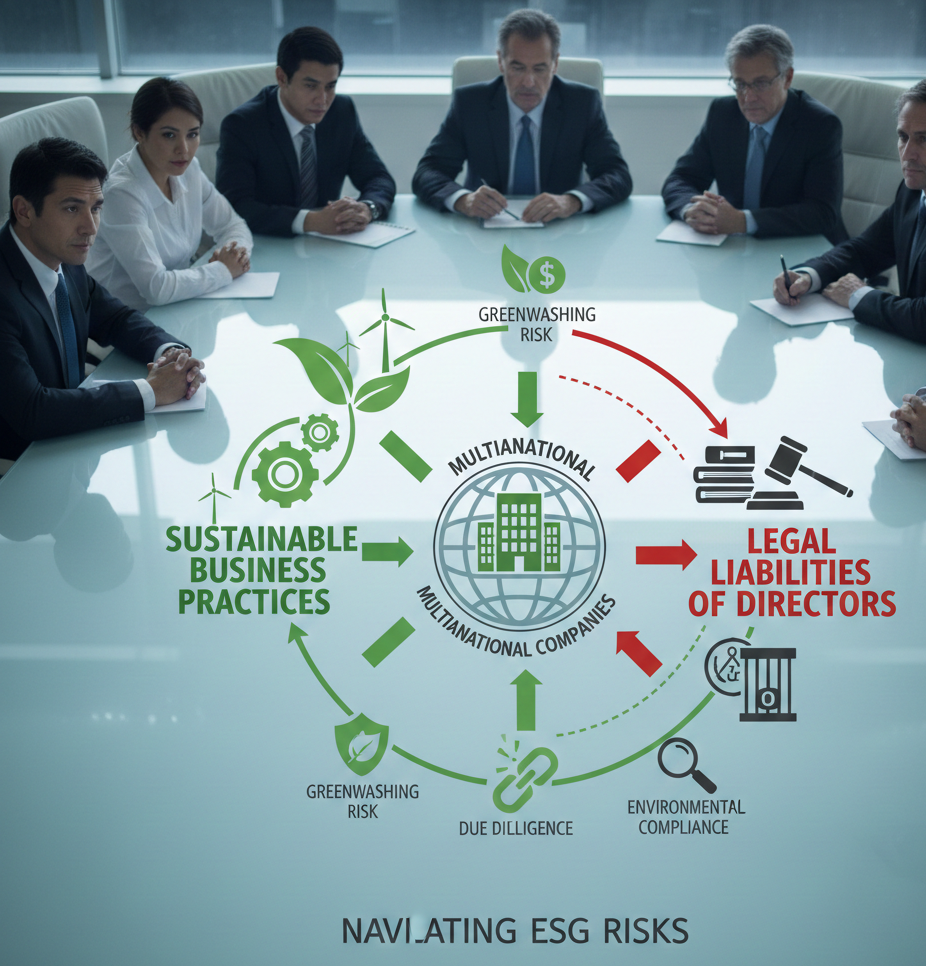
The global corporate landscape is currently undergoing a transformative shift as the paradigms of sustainable business practices move from the periphery of corporate social responsibility into the core of mandatory legal frameworks. For multinational companies (MNCs), this transition represents a departure from the traditional doctrine of shareholder primacy toward a model of stakeholder governance where environmental, social, and governance (ESG) factors are inextricably linked to fiduciary duties and personal liability for directors. This systemic evolution is driven by an unprecedented convergence of regulatory reforms, heightened investor expectations, and a burgeoning body of climate and human rights litigation that increasingly targets the decision-making processes of the boardroom. The institutionalization of ESG reporting has emerged as a central element of corporate transparency, reflecting a progression from voluntary disclosures toward standardized, mandatory frameworks intended to mitigate systemic risks such as climate change and societal inequality.
The Historical Trajectory and Conceptual Shift to ESG
The conceptual foundations of sustainable business practices have evolved through several distinct stages over the past seven decades. In the 1950s, the inception of Corporate Social Responsibility (CSR) was largely characterized by the ethical belief that business leaders have responsibilities extending beyond profit maximization, a concept first formalized by Howard Bowen. During this era, practices were primarily voluntary and ethical in nature, reflecting a nascent realization that corporate operations could have broader societal impacts. By the 1960s, a rise in social activism—driven by the civil rights movement and environmental protests—pressured corporations to address their impact on local communities and equitable employment.
Read also: International Trade Law in the Digital Era: The Legality of Electronic Documents and Smart Contracts
The 1970s marked a critical turning point as CSR expanded into a more strategic effort to mitigate risks and enhance corporate reputation. The publication of Rachel Carson’s Silent Spring in 1962 had already heightened regulatory scrutiny, leading boards to adopt proactive measures to demonstrate community commitment. However, it was not until the twenty-first century that the term ESG began to supplant CSR, representing a more tactical and data-driven approach where environmental and social considerations are blended with economic incentives to shape the core of business activities. Unlike the voluntary nature of traditional CSR, ESG integrates sustainability into the corporate strategy itself, aiming to enhance long-term shareholder value by addressing material risks.
| Era | Conceptual Framework | Governance Orientation | Primary Regulatory/Normative Drivers |
| 1950s | Early CSR | Ethical Voluntaryism | Academic theory (Bowen); Philanthropy |
| 1960s | Social Awareness | Reactive Compliance | Civil rights movement; Environmental activism |
| 1970s | Formalized CSR | Strategic Risk Mitigation | Silent Spring; Early environmental regulations |
| 2015-Present | ESG & Sustainability | Mandatory Stakeholder Governance | UN SDGs; Paris Agreement; IFRS S1/S2 |
The adoption of the United Nations Sustainable Development Goals (SDGs) in 2015 provided a concrete global agenda, setting targets for ending poverty and protecting the environment that have since been used as benchmarks for corporate performance. Research into Global Fortune 500 firms indicates that the introduction of the SDGs has been associated with significant governance improvements, particularly in developed economies, where mandatory reporting has driven environmental and social performance trajectories. Despite these advancements, the transition remains fraught with challenges, including fragmented assurance practices and the persistent risk of “greenwashing,” where companies exaggerate their ESG credentials to attract capital.
The International Minimum Standard for Responsible Business Conduct
For multinational companies, the legal and ethical baseline for sustainable operations is defined by the “International Minimum Standard,” which comprises the UN Guiding Principles on Business and Human Rights (UNGPs) and the OECD Guidelines for Multinational Enterprises on Responsible Business Conduct. This standard is applicable to all businesses regardless of size, industry, or location, and provides a cohesive management system for addressing potential adverse impacts on people and the environment.
The core mechanism of this standard is the implementation of a risk-based due diligence process. This involves six critical steps: (1) embedding responsible business conduct into policies and management systems; (2) identifying and assessing actual or potential adverse impacts; (3) preventing, ceasing, or mitigating those impacts; (4) tracking implementation; (5) communicating how impacts are addressed; and (6) providing for remediation. MNCs are increasingly expected to apply these principles not just to their own operations but across their entire global value chains, including both upstream suppliers and downstream business relationships.
| Component of International Standard | Operational Requirement | Legal Implication for Directors |
| Policy Commitment | Publicly stated expectation for business conduct | Establishes the standard for “Good Faith” oversight |
| Risk-Based Due Diligence | Six-step assessment of impacts | Duty of Care in monitoring “mission-critical” risks |
| Leverage & Influence | Responsibility to influence business partners | Potential liability for supply chain omissions |
| Access to Remedy | Establishment of grievance mechanisms | Mitigation of litigation risk via early detection |
The implications for directors are profound. Under the UNGPs, companies are required to have a Policy Commitment that outlines their expectations for business relationships. If an MNC becomes aware of severe impacts in its value chain, it is responsible for using its leverage to mitigate the harm; if such leverage is absent, the directorate is expected to build it. This expectation moves beyond passive compliance into active stewardship, where the failure to implement these due diligence steps can serve as evidence of a breach of the fiduciary duty of care.
The European Union’s Mandatory Legal Framework: CSDDD and CSRD
The European Union has taken the lead in transforming these international standards from voluntary guidelines into binding hard law. The Corporate Sustainability Due Diligence Directive (CSDDD), which entered into force in July 2024, creates a mandatory duty for large companies to identify and address human rights and environmental impacts across their global operations and supply chains.
Scope and Implementation Thresholds
The CSDDD applies to both EU and non-EU companies based on specific turnover and employee thresholds. For EU-based limited liability companies, the rules generally apply to those with more than 1,000 employees and a net worldwide turnover of more than EUR 450 million. For non-EU companies, the directive is triggered if they generate more than EUR 450 million in turnover within the Union. However, recent legislative developments in late 2025, specifically the “Omnibus I” amendments, have modified the compliance timeline and scope, pushing some mandatory compliance dates for certain companies to July 2029 to reduce regulatory burden while maintaining policy objectives.
The Civil Liability Mechanism
One of the most significant features of the CSDDD is the introduction of a civil liability regime. Article 22 (and later Article 29 in the final text) requires Member States to ensure that companies can be held liable for damages if they fail to meet their due diligence obligations, resulting in adverse impacts that should have been identified and mitigated. This allows natural or legal persons who are harmed by a company’s non-compliance to seek full compensation in European courts. Furthermore, the Directive mandates that companies adopt and put into effect a transition plan for climate change mitigation, ensuring their business models are compatible with the 2050 climate neutrality objective of the Paris Agreement.
Read also: The New Architecture of Geoeconomic Law: Sovereignty, Securitization, and the Fragmented Global Order in 2026
Administrative Supervision and Sanctions
Enforcement of the CSDDD is managed through a combination of administrative supervision and judicial action. Each Member State must designate a supervisory authority with the power to impose fines of up to 5% of a company’s net worldwide turnover for non-compliance. Beyond financial penalties, companies may face reputational sanctions and exclusion from public tenders. While original proposals included specific articles (Article 25 and 26) that explicitly defined a director’s duty of care to include sustainability interests, these were modified during the political compromise process, shifting the focus toward corporate liability while maintaining that directors must oversee the implementation of due diligence processes.
The North American Landscape: Regulatory Stalls and Sub-National Leadership
In the United States, the regulatory environment for sustainable business practices has been marked by significant volatility and legal challenges. The Securities and Exchange Commission (SEC) attempted to modernize climate disclosures in 2024, but these efforts have since been hampered by political shifts and litigation.
The SEC Climate Disclosure Rule Saga
In March 2024, the SEC adopted rules intended to standardize climate-related risks and greenhouse gas emissions reporting. However, following the change in the presidential administration in early 2025, the SEC’s stance shifted dramatically. In March 2025, the SEC voted to withdraw its defense of the climate disclosure rules in the Eighth Circuit, with Acting Chairman Mark Uyeda characterizing the rules as “costly and unnecessarily intrusive”. Commissioner Caroline Crenshaw dissented, arguing that this “policy-making through avoidance” fails to benefit investors or capital formation. As of early 2026, the litigation remains in abeyance, leaving a significant regulatory void at the federal level for MNCs operating in the U.S..
California’s Climate Disclosure Mandates
In the absence of federal action, the State of California has emerged as a critical regulator through Senate Bills 253 and 261. SB 253 (the Climate Corporate Data Accountability Act) requires companies with annual revenues exceeding $1 billion that do business in California to report their Scope 1, 2, and 3 emissions. SB 261 requires those with revenues over $500 million to disclose climate-related financial risks.
| California Legislation | Threshold | Primary Obligation | Current Status (Feb 2026) |
| SB 253 | > $1 billion revenue | Annual GHG emissions reporting (Scopes 1-3) | Stayed but allowed to proceed with implementing regs |
| SB 261 | > $500 million revenue | Climate-related financial risk reporting | Implementation paused by appeals court (Dec 2025) |
These laws are currently facing intense legal scrutiny, with the U.S. Chamber of Commerce and entities like Exxon Mobil alleging that they violate the First Amendment by compelling speech. Despite these challenges, many MNCs continue to prepare for compliance, given that the California Air Resources Board (CARB) is proceeding with the development of reporting programs.
Fiduciary Duties and Climate Risk: The Role of the Board
The legal liability of directors in the context of sustainability is fundamentally tied to the interpretation of fiduciary duties—primarily the duty of care and the duty of loyalty. In common law jurisdictions like the UK and Singapore, as well as in civil law systems like Indonesia, the question of whether a director has a duty to manage climate risk is no longer a matter of debate but one of application.
The UK Experience: ClientEarth v. Shell
The case of ClientEarth v. Shell’s Board of Directors represents a landmark moment in climate litigation. ClientEarth, as a minority shareholder, brought a derivative claim against Shell’s directors, alleging they had breached their duties under Sections 172 and 174 of the UK Companies Act 2006 by failing to adopt an adequate energy transition strategy. The claimants argued that by pursuing a strategy that was not Paris-aligned, the directors were mismanaging foreseeable financial risks.
The High Court dismissed the claim in 2023, a decision later upheld by the Court of Appeal. The court’s reasoning provided several key insights into the limits of judicial interference in corporate strategy:
- Management Discretion: The court emphasized that it is for directors themselves to determine, in good faith, how best to promote the success of a company. The “proper balancing” of competing commercial considerations in a business as complex as Shell falls within the realm of management decision-making, where the court is ill-equipped to interfere.
- Subjectivity of Duty: Section 172 requires a director to act in a way they consider most likely to promote the company’s success. This subjective test makes it extremely difficult to prove a breach unless the decision is one no reasonable board could have made.
- Shareholder Consensus: The court gave significant weight to the fact that 80% of Shell’s shareholders had approved the company’s energy transition policy, noting that the general meeting, not the courtroom, is the proper forum for such disputes.
Singapore: Clarifying Fiduciary Obligations
In Singapore, the legal landscape has been clarified by authoritative opinions suggesting that directors are obliged to consider climate change impacts as part of their duty to act in the best interests of the company. Failure to take into account material and adverse climate risks can lead to breaches of both common law and statutory duties, potentially resulting in fines, disqualification, or imprisonment under the Companies Act. The Singapore Exchange (SGX) has further reinforced this by mandating climate reporting for all listed issuers, holding directors responsible for ensuring that such disclosures are not misleading.
Comparative Analysis: Director Liability in Indonesia
Indonesia presents a unique case study where civil law principles and specialized environmental legislation create a high-risk environment for MNC directors. The regulatory framework is primarily governed by the Company Law (Law No. 40/2007) and the Environmental Protection and Management Law (Law No. 32/2009).
Read also: Development of Indonesian Anti-Dumping Law within the WTO Framework
Corporate Social and Environmental Responsibility (CSER)
Unlike many Western jurisdictions where CSR remains largely voluntary, Indonesian law mandates that companies operating in natural resource sectors carry out CSER. The failure to perform these duties is considered a breach of the company’s purposes and objectives, and directors can be held personally liable for any resulting losses.
Personal Liability and “Tanggung Renteng”
Under Article 97 of the Company Law, directors are personally and fully liable for company losses if they are at fault or negligent in their duties. In cases where the board consists of multiple members, this liability is joint and several (tanggung renteng). Directors can only escape this liability if they can prove that the loss was not due to their negligence, that they acted in good faith, that no conflict of interest existed, and that they took measures to prevent the loss.
Environmental Crimes and Strict Liability
The Indonesian Environmental Law (UUPPLH) introduces even more stringent standards. Article 116 allows for the prosecution of both the business entity and the individuals who gave the orders or led the activities resulting in environmental damage. The law applies the principle of “strict liability” (absolute liability) for activities that cause significant environmental harm, meaning the prosecution does not need to prove negligence if the damage occurred within the scope of the company’s operations.
| Case Type | Legal Basis | Director’s Risk Exposure |
| Peatland Fire Litigation | Ministry of Env. v. PT Waringin Agro Jaya | Personal liability for restoration costs (millions of Euros) |
| River Basin Degradation | Govt v. PT NSHE et al. (Jan 2026) | Joint and several liability for ecosystem recovery |
| Abuse of Authority | Art 97 Co. Law / Art 1 point 5 | Civil and criminal sanctions for ultra vires acts |
| Constitutional Protection | CC Ruling 119/PUU-XXIII/2025 | Increased exposure as anti-SLAPP rules empower activists |
The January 2026 lawsuits initiated by the Indonesian Ministry of Environment against six companies for Rp4.84 trillion in environmental damage demonstrate the government’s willingness to apply these principles aggressively. The recent Constitutional Court Ruling No. 119/PUU-XXIII/2025 further shifts the balance of power by expanding legal protections for environmental activists and experts, ensuring they cannot be criminalized for their advocacy, which is likely to increase the frequency and effectiveness of environmental litigation against MNCs.
Risk Management and the Evolving D&O Insurance Market
For directors of MNCs, the increasing risk of personal liability has made Directors and Officers (D&O) liability insurance a critical tool for risk mitigation. However, the D&O market is currently navigating a period of significant transition and tightening.
Trends in Securities Class Actions (SCA)
While the total number of securities class action filings saw a modest decrease in 2025 (207 filings compared to 232 in 2024), the severity of settlements has increased. The median settlement in 2025 rose to $17 million, a 21% increase from the previous year, reflecting a higher cost of litigation and larger recoveries for shareholders. Healthcare and technology companies remain the most frequent targets, but ESG-related claims are becoming a significant driver of new litigation.
The “Dual Litigation Trap” and Greenwashing
Directors now face a “dual litigation trap” regarding ESG. On one hand, companies are being sued for “greenwashing”—making misleading or unsubstantiated claims about their sustainability efforts. On the other hand, some activists and shareholders are filing suits alleging that the board has over-prioritized ESG goals at the expense of shareholder profit, or failed to properly manage the transition to a low-carbon economy.
D&O Policy Nuances and Exclusions
As risk profiles heighten, insurers are refining policy exclusions and demanding more robust financial and ESG data during the underwriting process. Key exclusions that directors must monitor include:
- Insolvency Exclusions: As global business insolvencies are expected to rise by 11% in 2024 and stabilize at high levels through 2026, lenders and shareholders are more likely to seek recovery from D&O policies. In some cases, insurers may add bankruptcy exclusions that bar coverage exactly when it is most needed.
- Conduct Exclusions: These bar coverage for deliberate fraud or criminal acts, but often require a “final adjudication” to be triggered, allowing directors to access defense costs until a final judgment is rendered.
- Pollution and Bodily Injury Exclusions: Traditionally, D&O policies exclude claims for environmental disasters, which may now conflict with ESG-related derivative claims. Directors should seek “securities claims carve-backs” to ensure they are protected if an environmental event leads to a drop in stock price and subsequent shareholder litigation.
The Impact of Emerging Technologies
Artificial Intelligence (AI) is also entering the boardroom as both a tool and a source of liability. “AI-washing”—the practice of overstating a company’s AI capabilities—has become a major liability risk in 2025, mirroring the trajectory of greenwashing. Directors face increasing scrutiny over their oversight of AI-related disclosures and the potential for technological failures to lead directly to shareholder lawsuits.
Best Practices for Governance and Risk Oversight
To navigate this complex environment, corporate boards must transition from a model of passive “risk management” to one of active “risk oversight.” Legal standards generally support the principle that boards should not be involved in day-to-day operations, but must engage in rigorous monitoring of key corporate risk factors.
Integration of ESG into Corporate Strategy
Sustainability should not be treated as a separate initiative or a “marketing” function but should be embedded into the corporate strategy and decision-making processes. This includes:
- Materiality Assessments: Identifying the ESG issues that matter most to the business and its stakeholders to ensure reporting is focused on relevant risks.
- Executive Compensation: Linking leadership incentives to ESG metrics, such as carbon reduction targets or labor standards, to ensure accountability.
- Dedicated Committees: Establishing formal ESG or sustainability committees to monitor regulatory changes and oversee due diligence implementation.
Strengthening Internal Controls and Transparency
Boards must satisfy themselves that risk management policies are functioning as intended and are consistent with the company’s long-term strategy. This requires:
- Director Training: Regular education on emerging risks, such as climate science, AI governance, and supply chain transparency laws.
- Stakeholder Engagement: Proactive communication with investors, employees, and communities to identify concerns early and build trust.
- Verifiable Reporting: Utilizing automated tools and independent third-party assurance to ensure the accuracy of sustainability data, thereby mitigating the risk of greenwashing and regulatory sanctions.
Crisis Preparedness and Legal Counseling
Given the heightened litigation environment, boards should work with management to develop crisis response plans that involve legal counsel, public relations, and human resources. Obtaining written legal opinions before major transactions and ensuring the adequacy of D&O insurance “Side A” coverage can provide critical layers of protection for individual directors.
| Governance Action | Primary Benefit | Legal Risk Mitigated |
| Linking Pay to ESG | Aligns executive behavior with long-term goals | Minimizes “Greenwashing” risk by incentivizing results |
| Board Training | Increases competence in “mission-critical” areas | Protects against “Caremark” failure-to-monitor claims |
| Materiality Assessments | Focuses resources on relevant risks | Reduces exposure to securities fraud from omitted info |
| Grievance Mechanisms | Early detection of value chain issues | Limits civil liability under CSDDD Art. 22/29 |
Conclusion: The Future of the “Triple Bottom Line”
The convergence of global regulatory frameworks, such as the EU’s CSDDD, and the clarification of fiduciary duties in common law and civil law jurisdictions has created a new standard for corporate stewardship. Directors of multinational companies can no longer rely on the shield of the Business Judgment Rule if they have failed to implement the necessary due diligence processes to monitor and mitigate environmental and social harms. While the rejection of the ClientEarth v. Shell claim in the UK suggests that courts remain reluctant to dictate specific corporate strategies, the proliferation of state-led litigation in Indonesia and sub-national regulation in California indicates that the “costs” of unsustainable practices are being internalized through massive financial and legal penalties.
As we move toward 2026, the D&O marketplace will continue to demand greater transparency, and the “dual litigation trap” will require boards to balance profit and sustainability with unprecedented precision. The most resilient MNCs will be those that view sustainability not as a compliance burden, but as an essential component of operational stability and long-term value creation. In this era of heightened accountability, the “triple bottom line”—people, planet, and profit—is no longer a management philosophy; it is a legal mandate for the twenty-first-century director.
Read also: Strategic Trade Defense: DSAP Law Firm’s Expertise in Antidumping and Safeguard Measures
Sources for article:
- researchgate.netThe Evolution of ESG and Sustainability Reporting: A Review of Standards, Challenges, and Impacts on Corporate Transparency – ResearchGate
- mdpi.comThe Evolution of ESG: From CSR to ESG 2.0 – MDPI
- tandfonline.comFull article: Forty-five years of research on corporate social responsibility (CSR) and sustainable development: an overview and research agenda – Taylor & Francis
- mdpi.comThe Evolution of Environmental, Social, and Governance (ESG) Performance: A Longitudinal Comparative Study on Moderators of Agenda 2030 – MDPI
- foundershield.comD&O Insurance Pricing: 2025 in Review, 2026 Outlook – Founder Shield
- ohchr.orgThe International Minimum Standard for Responsible Business Conduct – ohchr
- oecd.orgResponsible business conduct – OECD
- corporate-sustainability-due-diligence-directive.com
- lw.comThe EU’s Corporate Sustainability Due Diligence Directive …
- nacdonline.orgDirector Essentials: Directors & Officers Liability Insurance
- law.nyu.eduRisk Management and the Board of Directors | NYU Law
- ecgi.globalCivil Liability in the EU Corporate Sustainability Due Diligence Directive Proposal: A Law & Economics Analysis – ECGI
- normative.ioCSDDD, explained: the Corporate Sustainability Due Diligence Directive – Normative
- chapterzeroalliance.orgGuide on Climate Action for Boards in Southeast Asia
- commission.europa.euCorporate sustainability due diligence – European Commission
- eur-lex.europa.euConsolidated TEXT: 32024L1760 — EN — 17.04.2025 – EUR-Lex – European Union
- knowntrends.comEU Rolls Back CSRD Reporting and Corporate Sustainability Due Diligence Obligations
- corporate-sustainability-due-diligence-directive.com
- humanrights.dkTHE EU CORPORATE SUSTAINABILITY DUE DILIGENCE DIRECTIVE: – The Danish Institute for Human Rights
- akingump.comThe EU Corporate Sustainability Due Diligence Directive – Akin Gump
- rplt.itThe enforcement of the Corporate Sustainability Due Diligence Directive (CSDDD): what are the new scenarios about directors’ liability? – RPLT RP legalitax
- interdependencecoalition.euProtect Directors Duty of Care in the EU CSDDD – A Turning Point for Sustainable Corporate Governance – Interdependence Coalition
- corpgov.law.harvard.eduRegulatory Climate Shift: Updates on the SEC Climate-Related Disclosure Rules
- winston.comSEC Withdraws Defense of Climate Disclosure Rules – Winston & Strawn
- sec.govSEC Votes to End Defense of Climate Disclosure Rules
- huschblackwell.comDevelopments Regarding Federal and State Climate-Related Disclosure Requirements
- americanbar.orgThe Transatlantic Divide in ESG Disclosure Requirements: Why This Matters to Global Businesses – American Bar Association
- greencentralbanking.comUS appeals court pauses California’s disclosure rules – Green Central Banking
- lse.ac.ukClientEarth v Shell: What future for derivative claims? – LSE
- clientearth.orgClientEarth v Board of Directors of Shell plc
- tandfonline.comFull article: Climate change on the board: navigating directors’ duties
- climatecasechart.comClientEarth v. Shell’s Board of Directors – The Climate Litigation Database
- dorsey.comClientEarth v Shell plc Case Analysis: Directors’ Duties, Derivative Actions and ESG | News & Resources | Dorsey
- ccli.ubc.caLegal Opinion on Directors’ Responsibilities and Climate Change under Singapore Law
- blogs.law.ox.ac.ukDirectors’ Duties and the Controller’s Role in Relation to Climate Change: The Case of Singapore | Oxford Law Blogs
- wongpartnership.comClimate Change and Directors’ Liabilities – WongPartnership
- e-journal.fh.unmul.ac.idCorporate Criminal Liability on Environmental Law: Indonesia and Australia. – MulawarmanLawReview
- flevin.comLaw No. 40 of 2007 on Limited Liability Companies (BKPM)
- practiceguides.chambers.comESG 2025 – Indonesia | Global Practice Guides | Chambers and …
- researchgate.netA Comparative Legal Study of Commissioner and Shareholder Authority over Director Negligence Case: Indonesia vs. Singapore – ResearchGate
- seajbel.comTHE ACCOUNTABILITY OF THE DIRECTORS OF LLC (LIMITED LIABILITY COMPANY) FOR ENVIRONMENTAL CRIME IN INDONESIA – SEAJBEL
- environews.asiaIndonesia Sues Six Companies for US$310 Million Over Environmental Damage in North Sumatra – EnviroNews
- rwi.lu.seCase Repository: Indonesia – The Raoul Wallenberg Institute of Human Rights and Humanitarian Law
- jus.uio.noLandmark cases for protection of human rights defenders in Indonesia – UiO
- ssek.comLandmark Court Ruling Expands Legal Protection for Environmental Activists in Indonesia
- wtwco.comDirectors and officers (D&O) liability: A look ahead to 2026 – WTW
- baldwin.comPublic company D&O: from 2025 trends to 2026 expectations – The Baldwin Group
- agers.esDirectors and officers (D&O) insurance insights 2025 | AGERS
- reedsmith.comInsurance Coverage for Directors and Officers in ESG Disputes | ReedSmith
- americanbar.orgMitigating D&O Liability Post-Purdue: Best Practices for Insolvency Risk Management
- mavarick.aiESG in Corporate Governance: Best Practices for Driving Ethical Leadership – Mavarick
- thecorporategovernanceinstitute.comA sustainability checklist for boards of directors – The Corporate Governance Institute
- imd.org8 Best Practices in ESG Reporting for a Sustainable Strategy – IMD Business School
- researchgate.netLegal Liabilities of Corporate Directors: Navi