
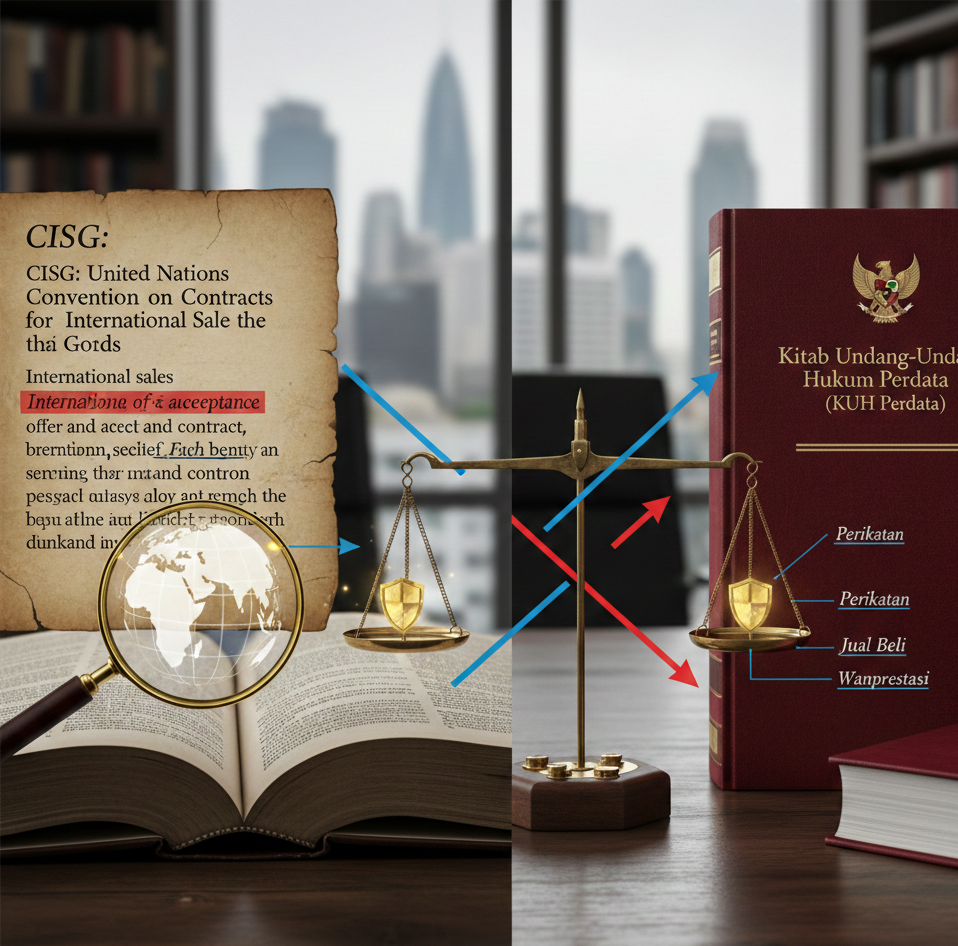
The landscape of international commerce is governed by a delicate tension between the drive for global legal harmonization and the persistent sovereignty of domestic civil frameworks. For practitioners and corporate entities operating within the Indonesian market, this tension is most acutely felt when navigating the selection of governing law in sales agreements. The United Nations Convention on Contracts for the International Sale of Goods (CISG) represents the pinnacle of international legislative efforts to provide a modern, uniform, and fair regime for the cross-border trade of goods, specifically designed to introduce certainty and decrease transaction costs by avoiding the complexities of private international law. Conversely, the Indonesian legal system, primarily anchored in the Indonesian Civil Code (Kitab Undang-Undang Hukum Perdata, or KUHPerdata), continues to operate under a framework largely inherited from 19th-century Dutch colonial law. This disparity creates a unique set of legal risks for international parties, particularly as Indonesia remains a non-Contracting State to the CISG as of early 2026. Consequently, mitigating risk in this jurisdiction requires a profound understanding of the intersections between international lex mercatoria and the specific, often rigid, requirements of Indonesian civil and procedural law.
The Jurisprudential Divide: Conceptual Frameworks of CISG and KUHPerdata
The CISG serves as a source of inspiration for many regional and national laws, yet its primary utility lies in its direct application to contracts between parties with places of business in different Contracting States. Its dispositive nature allows parties to adapt its default rules to their individual needs, using tailor-made contractual changes while benefiting from a neutral body of rules that transcends domestic biases. In the Indonesian context, however, the Civil Code remains the default governing law for domestic and many international transactions where Indonesian law is designated. The KUHPerdata is divided into four books, with Book III focusing on obligations, which includes the principles of freedom of contract and the binding force of agreements.
The fundamental difference between these two regimes lies in their developmental age and their target audience. While the CISG is specifically tailored to the nuances of modern international commercial transactions between private businesses, the Indonesian Civil Code is a generalist instrument that applies to a broad range of civil relationships without the specific commercial focus found in the Convention. This generalist nature often leads to inadequacies when addressing the high-velocity requirements of modern commodity markets or complex industrial sales.
Comparative Table: Structural and Philosophical Divergence
| Feature | CISG (Vienna, 1980) | Indonesian Civil Code (Book III) |
| Origin and Context | UNCITRAL; International trade focus | 1847 Dutch Civil Code; General civil focus |
| Adoption Status | 97 Contracting States globally | Non-signatory; Domestic codification |
| Party Autonomy | Central; Parties may exclude or vary | Core; Agreements apply as law (Art. 1338) |
| Good Faith Principle | Tool for international interpretation | Mandatory performance standard (Art. 1338) |
| Primary Remedial Goal | Contract preservation (Fundamental Breach) | Restitution and damages (Wanprestasi) |
The principle of party autonomy is perhaps the most critical bridge between these two systems. Article 1338 of the Indonesian Civil Code stipulates that all agreements made legally shall apply as law for the parties who have made them. This provision effectively allows Indonesian parties to incorporate the CISG into their contracts by reference, even though Indonesia has not formally ratified the treaty. However, such incorporation is not without risk, as mandatory provisions of Indonesian law—particularly those relating to public order, morality, and specific formal requirements—cannot be bypassed by contractual agreement.
Contract Formation and the Validity of Consent
In international sales, the moment of contract formation is a high-risk juncture. The CISG approaches formation through a technical process of offer and acceptance, governed by Part II of the Convention. An offer is considered effective when it reaches the offeree, and it must be sufficiently definite, indicating the goods and the price. The key element in acceptance is the offeree’s indication of assent, which must match the offer in every respect; otherwise, it constitutes a counter-offer.
Indonesian law, by contrast, relies on the four pillars of validity established in Article 1320 of the Civil Code. For a contract to be valid, it must satisfy: (1) the mutual consent of the parties, (2) the legal capacity to enter into an obligation, (3) a specific subject matter, and (4) a lawful cause. The first two conditions are subjective, meaning their absence allows one party to request the cancellation of the contract. The latter two are objective, and their failure renders the contract null and void ab initio, as if it never existed.
The Impact of Subjective and Objective Conditions
The distinction between voidable and void contracts in Indonesia is a critical risk factor for international sellers. If an Indonesian counterparty lacks the capacity to sign—for example, if a corporate representative acts beyond their delegated authority—the contract is not automatically void but can be cancelled by an Indonesian judge. This creates a period of uncertainty where the contract remains binding until a court intervenes. Conversely, if the subject matter of the contract is not “ascertainable” or “tradeable” as per Article 1332, the contract is dead on arrival. The requirement for a “lawful cause” further implies that any contract violating Indonesian statutory law or public morality is unenforceable.
| Validity Condition (Art. 1320) | Type | Legal Consequence of Failure |
| Mutual Consent | Subjective | Voidable (Cancellation by judge) |
| Legal Capacity | Subjective | Voidable (Cancellation by judge) |
| Specific Subject Matter | Objective | Null and Void (Deemed never made) |
| Lawful Cause | Objective | Null and Void (Deemed never made) |
The CISG’s focus on the “technical process” of concluding a contract often bypasses these deeper “validity” questions, as Article 4 expressly excludes the validity of the contract or any of its provisions from the Convention’s scope. This means that even if a contract is governed by the CISG, the question of whether a party had the legal capacity to sign is still governed by the applicable domestic law—in this case, Indonesian law.
Formalities and the Language Law Challenge
A significant idiosyncratic risk in Indonesian contracting is the statutory language requirement. Law No. 24 of 2009, complemented by Presidential Regulation No. 63 of 2019, mandates that the Indonesian language must be used in any memorandum of understanding or agreement involving an Indonesian private entity or individual. For years, this was a primary tool for Indonesian parties seeking to escape unfavorable agreements, as courts frequently annulled English-only contracts on the grounds that they lacked a “lawful cause” by violating the Language Law.
However, the legal landscape shifted dramatically with the issuance of Supreme Court Circular Letter No. 3 of 2023 (SEMA 3/2023). The Supreme Court clarified that the absence of an Indonesian language version cannot be used as a basis to annul a contract unless the absence was caused by a party acting in bad faith. While this provides a “breath of fresh air” for international investors, it does not waive the requirement; rather, it shifts the burden of proof. The party seeking nullification must now prove that their counterparty intentionally omitted the Indonesian version to deceive or disadvantage them.
Best Practices for Language Compliance
Despite the protections of SEMA 3/2023, the conservative and safest mitigation strategy remains the execution of bilingual contracts. Under the prevailing regulations, if a foreign party is involved, the agreement must be in the language of that party or English, alongside the Indonesian version. Practitioners typically include a “prevailing language” clause which stipulates that in the event of a discrepancy, the English version shall prevail. While some Indonesian scholars suggest that the Indonesian version must always prevail by law, modern arbitral practice often respects the parties’ choice of a prevailing language, provided both versions were executed simultaneously.
The Passing of Risk: Navigating Article 1460
In the sale of goods, the moment the risk of loss or damage passes from the seller to the buyer is of paramount financial importance. The default rules in the Indonesian Civil Code are famously problematic for sellers and buyers alike. Article 1460 of the KUHPerdata stipulates that for a “specific thing” (a determinate object), the risk passes to the buyer the moment the contract is concluded, even if delivery has not yet taken place. This deviates significantly from the CISG, where risk generally transfers when the goods are handed over to the first carrier or the buyer takes delivery.
If an international contract for a specific piece of machinery is governed by Indonesian law and the parties remain silent on the passing of risk, the buyer could theoretically be held liable for the price even if the machine is destroyed in a warehouse fire before it even reaches the port. This “Conclusion-Based Risk” model is widely seen as unsuitable for modern trade, where goods must cross multiple borders and are subject to diverse transport risks.
Mitigation via Incoterms 2020
The primary risk mitigation tool against Article 1460 is the explicit incorporation of Incoterms 2020. Incoterms are the authoritative rules for determining how costs and risks are allocated between parties. Because Incoterms provide specific points for risk transfer (e.g., when goods are loaded on a vessel for FOB, or handed to a carrier for FCA), they effectively override the default provisions of the Civil Code.
| Incoterm 2020 | Risk Transfer Point | Implications for Indonesian Contracts |
| EXW (Ex Works) | When goods are made available at the seller’s premises | Places maximum risk on the buyer; similar to Art. 1460. |
| FCA (Free Carrier) | When goods are handed to the carrier | Preferred for containerized cargo to avoid pre-shipment risk. |
| CIF (Cost, Insurance, Freight) | When goods are placed on board the vessel | Seller pays freight but risk transfers at the port of origin. |
| DPU (Delivered at Place Unloaded) | When goods are unloaded at the destination | Places maximum risk on the seller until the end of the journey. |
The 2020 update to Incoterms introduced specific changes to the FCA rule to accommodate bank requirements for “on-board” bills of lading, allowing parties to agree that the buyer will instruct the carrier to issue such a document to the seller after loading. Furthermore, for CIP (Carriage and Insurance Paid To), the level of mandatory insurance was increased to Clause (A) of the Institute Cargo Clauses, providing broader protection for the buyer compared to the previous version.
Obligations and Conformity of Goods
The CISG imposes a strict duty on the seller to deliver goods in conformity with the contract’s quantity, quality, and packaging requirements (Article 35). This includes an implied warranty that the goods are fit for their ordinary purpose or any specific purpose made known to the seller. In the event of non-conformity, the buyer must notify the seller within a “reasonable time” after discovery, typically interpreted by courts as a period between two to four weeks.
The Indonesian Civil Code handles non-conformity primarily through the lens of “hidden defects” (cacat tersembunyi), regulated under Articles 1504 to 1509. The seller is obligated to warrant the buyer against defects that make the goods unfit for their intended purpose or diminish their usefulness. Crucially, the seller is responsible for these defects even if they were unaware of them at the time of sale.
The Notice Period Disparity
The notice requirement in Indonesia is defined as a “short time period” based on the nature of the goods and local customs. However, Article 1454 of the Civil Code suggests that if no specific law regulates the claim, the default period for cancellation is five years. This creates a much longer tail of liability for sellers under Indonesian law than the two-year absolute cutoff found in Article 39(2) of the CISG.
| Legal Aspect | CISG | Indonesian Civil Code |
| Standard of Conformity | Article 35 (Fitness for purpose) | Articles 1504-1506 (Hidden defects) |
| Notification Requirement | “Reasonable time” (Art. 39) | “Short period” (Art. 1504) |
| Absolute Cutoff | 2 years from delivery (Art. 39) | Potentially 5 years (Art. 1454) |
| Seller’s Knowledge | Liability regardless; notice waived if known | Liability regardless; higher damages if known. |
For a buyer in Indonesia, the options upon discovering a hidden defect are: (1) returning the goods and demanding a full refund of the purchase price, or (2) retaining the goods and demanding a partial refund as determined by a judge following an expert’s assessment. If the seller knew of the defect and failed to disclose it, they are liable for all costs, losses, and interest incurred by the buyer.
Breach and the Remedial Framework
The remedial structures of the CISG and Indonesian law diverge in their approach to contract termination. The CISG operates on the principle of “Fundamental Breach” (Article 25). A breach is fundamental only if it results in such detriment to the other party that they are substantially deprived of what they were entitled to expect under the contract. This high threshold is designed to prevent the casual termination of international contracts for minor deviations, favoring price reduction or repair instead.
In contrast, the Indonesian Civil Code relies on the concept of wanprestasi (default or broken promise). A debtor is in wanprestasi if they fail to perform, perform late, or perform improperly. Unlike the CISG, the Civil Code does not inherently recognize a “fundamental” threshold for all contracts; rather, Article 1266 stipulates that the power to dissolve a contract is implied in reciprocal agreements, but it must be requested through a judge.
The Requirement for Somasi (Notice of Default)
In Indonesia, a breach does not automatically become a default. A formal “Somasi” (Notice of Default) is generally required to give legal effect to the breach. This notice must identify the specific obligation breached, set a reasonable deadline for correction (typically 7 to 14 days), and state the consequences of non-compliance. Without a valid Somasi, an Indonesian court may conclude that a lawsuit was filed prematurely and reject the claim. This is a critical procedural risk for international parties who are used to the CISG’s more automatic remedial triggers.
Anticipatory Breach: The Missing Link
One of the most profound legal gaps in Indonesia is the absence of explicit regulation for “Anticipatory Breach”. The CISG (Articles 71 to 73) allows a party to suspend or avoid a contract if it becomes clear that the other party will commit a fundamental breach. This provides essential protection in volatile markets. Indonesian law, however, traditionally requires the innocent party to wait until the performance date has passed before they can legally declare a default. While modern interpretations of “Good Faith” (Article 1338) are being used by scholars to argue for an implicit recognition of anticipatory breach, the lack of statutory certainty remains a significant risk.
Force Majeure and Hardship
The ability to excuse non-performance during crises is governed by Articles 1244 and 1245 of the Indonesian Civil Code, which recognize force majeure (overmacht). For an event to qualify, it must be unforeseeable at the time of contracting, beyond the control of the parties, and must render performance impossible.
Indonesian law differentiates between “Absolute Force Majeure” (permanent impossibility) and “Relative Force Majeure” (temporary hindrance or extreme difficulty). The latter often overlaps with the international concept of “Hardship,” where performance remains possible but becomes excessively burdensome, such as during a drastic currency devaluation. While hardship is not expressly recognized in Indonesian statute, parties can make it binding by including specific hardship or “renegotiation” clauses in their contracts, which is consistent with the principle of freedom of contract.
Comparative Framework of Excuses
| Condition | CISG (Art. 79) | Indonesian Civil Code |
| Standard | “Impediment beyond control” | “Unforeseen event” preventing performance. |
| Foreseeability | Must be taken into account at conclusion | Must be unanticipated at signing. |
| Hardship | High threshold; rarely excuses | Not codified; recognized if in contract. |
| Remedy | Exemption from damages | Release from damages and interest. |
The CISG’s Article 79 similarly focuses on “impediments beyond control,” but it is generally interpreted more narrowly than the Indonesian concept of overmacht, which can encompass a wider array of geological, weather-related, and government-policy events.
Dispute Resolution: Enforcement and Arbitration
The choice of forum is perhaps the most significant “mitigation” decision in an Indonesian sales contract. A fundamental reality of the Indonesian legal system is that foreign court judgments are not enforceable. Based on Article 436 of the RV (an old procedural code), a foreign judgment can only serve as prima facie evidence in a new lawsuit filed in an Indonesian court. This re-litigation process is time-consuming, costly, and offers no guarantee that the original verdict will be upheld.
The Arbitration Advantage
Arbitration is the preferred method for resolving cross-border disputes in Indonesia because foreign arbitral awards are enforceable under the 1958 New York Convention. Indonesia ratified this convention via Presidential Decree No. 34 of 1981, and its implementation is further guided by Law No. 30 of 1999.
SIAC vs. BANI: Institutional Comparison for 2026
| Feature | SIAC (Singapore) | BANI (Indonesia) |
| Enforceability | Requires exequatur from Jakarta CDCJ. | Registered with local district court. |
| Seat Influence | Singapore seat offers more neutrality. | Indonesia seat subjects rules to Law 30/1999. |
| Language | English common; translation needed for court. | Bahasa Indonesia mandatory for filings. |
| Emergency Relief | Mature “Emergency Arbitrator” mechanism. | Introduced in 2025 Rules. |
| Cost | High (international rates). | Lower (MSME-friendly). |
The 2025 BANI Rules represent a significant step toward international standards, including provisions for emergency arbitrators and digital hearings. However, for high-value transactions, the Singapore International Arbitration Centre (SIAC) remains the regional leader due to its procedural transparency and the strong support of the Singaporean judiciary. It is critical to note that any SIAC award “seated” in Indonesia must still comply with Indonesian mandatory procedural norms to avoid annulment.
The Public Policy Wildcard
Both foreign awards and local proceedings face the risk of “Public Policy” (ketertiban umum) objections. While the definition has been narrowed by Supreme Court Regulation No. 3 of 2023, the Central Jakarta District Court still examines applications for enforcement on a case-by-case basis. Awards that are seen as violating Indonesian state sovereignty or mandatory laws (like the Language Law before SEMA 3/2023) remain vulnerable.
Emerging Risks in the 2026 Regulatory Environment
As of February 2026, several new regulatory frameworks have entered into force, adding layers of risk to international sales contracts.
Human Rights Due Diligence
A new Presidential Regulation (New Perpres) is expected to be in force by mid-2026, requiring Indonesian businesses to conduct human rights due diligence. This regulation aligns Indonesia with global trends like the EU’s Corporate Sustainability Due Diligence Directive. Businesses will be required to identify, prevent, and mitigate human rights risks within their operations and supply chains. For international sellers, this means that “Representations and Warranties” regarding labor practices and environmental standards are no longer merely boilerplate but mandatory compliance items.
Personal Data Protection and the Digital Agency
Following the transition period of the Personal Data Protection (PDP) Law, the Indonesian government is establishing a dedicated PDP Agency in 2026. This agency will oversee the implementation of strict data protection standards, and businesses must ensure their contracts account for these requirements, particularly in digital sales and services. Non-compliance can lead to significant administrative and criminal penalties under the New Penal Code (KUHP) which took effect on January 2, 2026.
Conclusion: Integrated Risk Mitigation Strategy
Mitigating legal risks in international sales contracts involving Indonesia requires a dual-track strategy. On one hand, parties must leverage the flexibility of the CISG—either by choosing it as the governing law for foreign entities or by incorporating its principles into Indonesian-governed contracts. On the other, they must strictly adhere to the mandatory formalities of the Indonesian Civil Code, particularly regarding language, somasi, and the passing of risk.
The strategic use of Incoterms 2020 remains the most effective way to manage the “Conclusion-Based Risk” of Article 1460 KUHPerdata. Furthermore, the selection of arbitration—specifically through institutions like SIAC or the modernized BANI—is essential to bypass the hurdle of non-enforceable foreign court judgments. As Indonesia moves toward further legal modernization in 2026 with new due diligence and data protection standards, the role of proactive, detailed contractual drafting has never been more vital for ensuring the continuity and security of international trade.
Sources for article:
- uncitral.un.orgUnited Nations Convention on Contracts for the International Sale of Goods (Vienna, 1980) (CISG)
- acerislaw.comThe United Nations Convention on Contracts for the International Sale of Goods (CISG)
- bphn.go.idCISG – BPHN
- media.neliti.comHARMONIZATION OF INTERNATIONAL SALES LAW: CISG … – Neliti
- cisg-online.orgCISG by jurisdiction | CISG-online.org
- cisg-online.orgCISG-online | CISG-online.org
- uncitral.un.orgInternational Sale of Goods (CISG) and Related Transactions
- journal.jfpublisher.comComparative Study of the Doctrine of Repudiation of Contract in the …
- ssek.comExclusive Jurisdiction and CISG for Contracts under Indonesian Law
- ijsr.internationaljournallabs.comIMPLEMENTATION OF GOOD FAITH PRINCIPLES IN TRADE CONTRACTS IN INDONESIA – Journal of Social Research
- ejurnal.iblam.ac.ida contract reviewed from the perspective of civil law in indonesia may be delayed due to force majeure
- uncitral.un.orgSelected problems concerning the CISG’s scope of application – United Nations Commission on International Trade Law (UNCITRAL)
- lexagle.comA Comprehensive Guide to Indonesian Contract Law – Lexagle
- insightplus.bakermckenzie.comIndonesia: Indonesian Supreme Court’s opinion on contract language requirement – a breath of fresh air? – Baker McKenzie InsightPlus
- allenandgledhill.comSupreme Court of Indonesia provides guidance on Indonesian translations of agreements
- siac.org.sgNEWSLETTER – Singapore International Arbitration Centre
- nagashima.comSupreme Court Clarifies the Necessity of Bahasa Indonesia Version in an Agreement | Publications | Nagashima Ohno & Tsunematsu
- rouse.comIndonesia: Clarification on Language Requirement for Contracts – Rouse
- cisg-online.orgPassing of Risk in International Sale Contracts under the CISG
- scribd.comSummary of Key Points From Article 1460 – 1465 | PDF | Sales | Foreclosure – Scribd
- iccindonesia.orgIncoterms® 2020 – ICC Indonesia
- iupress.istanbul.edu.trINCOTERMS® 2020 Rules on International Sales and Transfer of Risks – Istanbul University Press
- traderiskguaranty.comNotable Changes in Incoterms 2020 | International Trade |
- iccwbo.orgIncoterms® 2020 – ICC – International Chamber of Commerce
cisgac.comCISG Advisory Council Opinion No 21
dandapala.comAnticipatory Breach, A Missing Piece In Indonesian Contract Law – DandapalaOpens in a new windowdandapala.comAnticipatory Breach, A Missing Piece In Indonesian Contract Law
schinderlawfirm.comForce Majeure and Hardship in Indonesian Contracts: Key Insights for Businesses
scholarhub.unhas.ac.idDealing with Unexpected Circumstances: Judicial Modification of …
dandapala.comA Brief Analysis on Indonesia’s Law on Recognition & Enforcement of Foreign Judgments
cms.lawRecognition and enforcement of foreign judgments in Indonesia – CMS
law.asiaEnforcement of foreign arbitral awards in Indonesia – Law.asiaOpens in a new window
law.asiaIndonesia’s arbitration law and institutions | SSEK – Law.asia
pbs.orgIndonesia’s new penal code takes effect, marking historic