
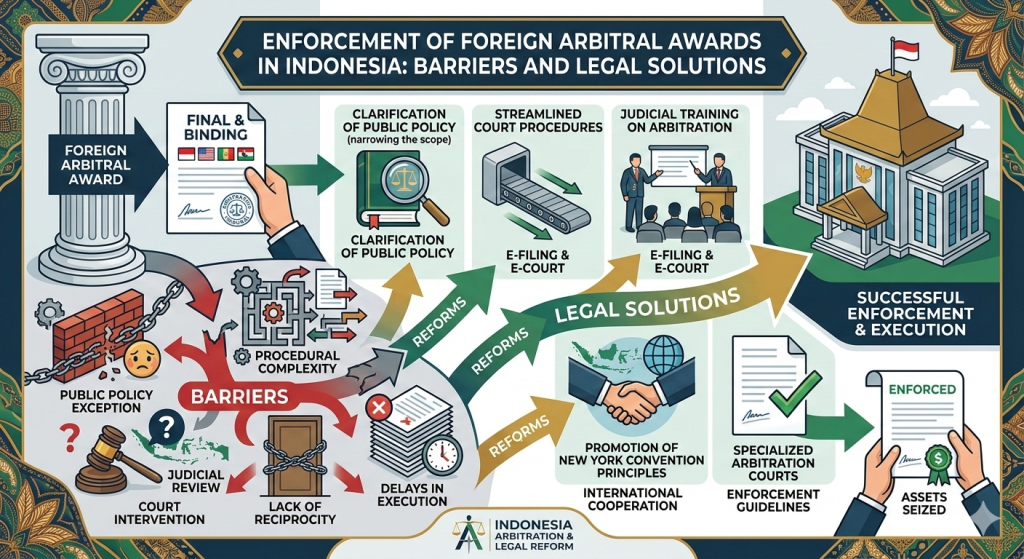
The Geopolitical and Economic Context of Indonesian Arbitration
The enforcement of foreign arbitral awards in Indonesia represents a critical intersection between national sovereignty, international treaty obligations, and the imperatives of global commerce. As the largest economy in Southeast Asia, Indonesia has long recognized that the efficacy of its dispute resolution framework is a primary determinant of its attractiveness to foreign direct investment. However, the path toward a predictable and “arbitration-friendly” environment has been characterized by significant legal volatility, rooted in a complex post-colonial legal history and a judiciary that has historically guarded its jurisdiction with tenacity. The foundational instrument for this regime, Law No. 30 of 1999 on Arbitration and Alternative Dispute Resolution, was enacted during a period of intense economic reform following the 1997 Asian financial crisis. While this law replaced outdated colonial regulations and signaled a modernization of Indonesia’s legal infrastructure, its implementation has revealed deep-seated barriers that only recently have begun to be addressed through landmark judicial decisions and innovative Supreme Court regulations.
The importance of this subject is underscored by the global shift toward arbitration as the preferred mechanism for resolving cross-border commercial and investment disputes. Statistics generally indicate that a vast majority of parties comply with arbitral awards voluntarily, but the true test of an arbitration regime lies in those instances where compliance is absent and the coercive power of the state must be invoked. For Indonesia, a signatory to the 1958 New York Convention since 1981, the obligation to recognize and enforce foreign awards is clear under international law. Yet, the domestic application of these obligations has frequently been hindered by procedural obscurities, a broad interpretation of public policy, and a lack of clear timelines for judicial action. The recent reforms between 2023 and 2025, including the introduction of Supreme Court Regulation No. 3 of 2023 and the Constitutional Court Decision No. 100/PUU-XXII/2024, represent a “new dawn” for arbitration in the country, seeking to harmonize Indonesian practice with international standards such as the UNCITRAL Model Law.
The Statutory and Institutional Framework
The Indonesian arbitration regime is governed by a hierarchy of norms that begins with international treaties and descends into specific national statutes and implementing regulations. At the apex is the New York Convention on the Recognition and Enforcement of Foreign Arbitral Awards, ratified by Indonesia through Presidential Decree No. 34 of 1981. This treaty serves as the cornerstone for the enforcement of international awards, ensuring that awards rendered in other contracting states are recognized as binding and enforceable within Indonesian territory. Following the 1999 Arbitration Law, which was a direct consequence of Indonesia’s adherence to the New York Convention, the country established a framework that formally recognizes party autonomy and the finality of arbitral decisions.
Despite this framework, Law No. 30 of 1999 remained unchanged for over 24 years, leading to concerns among scholars and professionals that the law was no longer sufficient to meet the evolving demands of the international business community. One of the primary criticisms was that the law did not adopt the UNCITRAL Model Law, which has become the gold standard for arbitration legislation globally. This lack of alignment created a “loophole” environment where judicial interference was common and the definition of what constituted an “international” award was left dangerously ambiguous.
Evolution of the Regulatory Framework
| Instrument | Effective Date | Primary Purpose | Key Contribution |
| New York Convention | 1981 (Ratified) | International recognition of awards | Obligation to enforce foreign awards based on reciprocity. |
| Law No. 30 of 1999 | August 12, 1999 | National Arbitration and ADR Law | Replaced colonial-era regulations; defined commercial scope. |
| PERMA No. 1 of 1990 | 1990 | Procedural guidance | Established early procedures for foreign award execution. |
| PERMA No. 3 of 2023 | Q4 2023 | Procedural modernization | Introduced strict timelines and electronic submission (SIP). |
| BANI Rules 2025 | January 2, 2025 | Institutional rules update | Formalized emergency arbitration and multi-party clauses. |
The institutional landscape is dominated by the Indonesian National Board of Arbitration (Badan Arbitrase Nasional Indonesia or BANI), which remains the preeminent body for both domestic and international commercial disputes. The recent 2025 update to the BANI Rules demonstrates a significant push toward international standards, introducing concepts like emergency arbitration and expanded grounds for challenging arbitrators. Furthermore, the establishment of sector-specific bodies, such as the Indonesian Board of Arbitration for Energy Disputes (BASE) in 2024, indicates a growing specialization in the Indonesian arbitral market to address high-value disputes in the mining and energy sectors.
Classification and the Territoriality Principle
A perennial barrier to the effective enforcement of awards in Indonesia was the ambiguity surrounding the classification of awards as either “domestic” or “international.” Under Article 1(9) of the 1999 Arbitration Law, international awards were defined as those rendered outside Indonesia or those “considered” or “deemed” to be international under Indonesian law. This second limb of the definition granted courts excessive discretion. Judges could reclassify an award rendered in Jakarta as “international” simply because the underlying contract involved foreign currency, used the English language, or was governed by foreign institutional rules such as those of the ICC.
This classification was not merely academic; it had profound jurisdictional consequences. If an award rendered in Jakarta was deemed “international,” Indonesian courts frequently concluded that they lacked the authority to set it aside, as they believed their annulment power only extended to “national” (domestic) awards. Simultaneously, because the physical seat was in Indonesia, foreign courts also lacked jurisdiction to annul the award. This created a “legal vacuum” where a potentially flawed award was immune to challenge in any jurisdiction, yet remained enforceable.
Constitutional Court Decision No. 100/PUU-XXII/2024
On January 3, 2025, the Constitutional Court issued a landmark ruling that sought to resolve this ambiguity by striking down the “considered” or “deemed” wording in Article 1 point 9. The Court acknowledged that this phrase led to multiple and subjective interpretations, creating uncertainty for both litigants and the judiciary. By removing this limb, the Court established a “pure territoriality principle” for the classification of arbitral awards.
The implication of this decision is that until lawmakers enact specific new criteria, an award is classified solely based on the place where it is rendered. An award issued in the territory of the Republic of Indonesia is now strictly a domestic award, regardless of the nationality of the parties or the choice of foreign arbitration rules. This ensures that Indonesian courts retain their supervisory jurisdiction over awards rendered within their borders, providing parties with a clear path for seeking annulment under Article 70 of the 1999 Law. For international users, this provides essential legal certainty: if they choose a seat outside Indonesia, the resulting award will be treated as a foreign award subject to the exequatur process at the Central Jakarta District Court.
Procedural Workflow for Foreign Award Enforcement
The enforcement of a foreign arbitral award in Indonesia is a centralized and multi-stage process that must navigate specific bureaucratic and judicial requirements. Unlike domestic awards, which can be registered at the local district court of the respondent’s domicile, all foreign awards must be processed through the Central Jakarta District Court (CDCJ). The process is generally divided into three stages: registration, obtaining an exequatur, and final execution.
Registration and Authentication Requirements
The first step is the formal registration of the award. Under the 1999 Law, the award must be registered by the arbitrator or their proxy. This is a notable departure from many other jurisdictions where the parties themselves can handle registration. While domestic awards must be registered within 30 days of issuance to remain enforceable, the Supreme Court clarified in Pertamina v. Lirik Petroleum (2010) that this 30-day deadline does not apply to foreign awards. However, practitioners strongly advise prompt registration—ideally within 14 days of receipt—to mitigate risks and align with the spirit of the newer Supreme Court regulations.
The documentation required for registration is highly formalized. Any defect in the documentation can lead to a summary rejection of the enforcement request. The applicant must submit the original or an authenticated copy of the award, along with the original or an authenticated copy of the underlying arbitration agreement. Both documents must be accompanied by certified Indonesian translations provided by a sworn translator. Additionally, a critical “reciprocity statement” is required from the Indonesian diplomatic mission in the country where the award was rendered, confirming that the country and Indonesia are jointly bound by a treaty on the recognition and enforcement of awards.
Document Authentication Standards
| Document | Legalization/Authentication Method |
| Foreign Arbitral Award | Legalized by Indonesian Representative in the seat country or Apostille |
| Arbitration Agreement | Legalized by Indonesian Representative or Apostille |
| Power of Attorney | Specialized POA legalized by a Notary and relevant authorities |
| Indonesian Translation | Must be performed and certified by a sworn translator |
| Embassy Statement | Issued by the Indonesian Embassy in the country where the award was rendered |
The authentication process for foreign documents has been modernized through the adoption of the Apostille procedure. Applicants can now utilize an online system to upload identity documents and requests for Apostille, which simplifies the previously arduous chain of manual legalizations. However, the requirement for a statement from the Indonesian embassy remains a unique hurdle that necessitates proactive coordination with diplomatic offices in the seat of arbitration.
The Exequatur Order
Once the award is registered, the winning party must apply for an exequatur (an order permitting enforcement) from the Chairman of the CDCJ. The court’s role at this stage is limited to a formal and legal review rather than an examination of the merits of the case. The Chairman must verify that the award falls within the domain of commercial law, does not violate Indonesian public policy, and satisfies the principle of reciprocity.
Under the 1999 Law, there was no specific timeframe for the Chairman to decide on the exequatur, leading to significant delays. This changed with the issuance of PERMA No. 3 of 2023, which mandates that the court issue an order granting or refusing the exequatur within 14 calendar days of a complete request. If the exequatur is granted, the ruling stands as final and binding, with no legal remedies available to the losing party to appeal the recognition. If, however, the exequatur is refused, the applicant has the right to file an appeal (Cassation) to the Supreme Court.
Barriers to Enforcement: The Public Policy Exception
The most significant substantive barrier to the enforcement of foreign awards in Indonesia is the public policy exception (ketertiban umum). While Article V(2)(b) of the New York Convention allows for refusal if enforcement would be contrary to the public policy of the country, Indonesian courts have historically interpreted this concept with considerable breadth and inconsistency. The public policy defense is often employed as a “final recourse” to contest an award when procedural arguments have failed.
The Broad Definition of Public Order
Under the older PERMA No. 1 of 1990, public order was defined as the “basic principles of the legal system and society in Indonesia”. PERMA No. 3 of 2023 has attempted to refine this, defining it as the essential foundation for the operation of the legal, economic, and socio-cultural systems of the nation. Despite this attempt at refinement, the concept remains a “wild horse” that allows judges wide discretion. In many instances, a mere violation of an Indonesian law has been treated as a violation of public policy, whereas in jurisdictions like the UK or USA, a distinction is drawn between mandatory laws and the much higher threshold of “international public policy”.
Sovereignty and Judicial Interference: The Astro Case
The case of Astro All Asia Network Plc. v. PT Ayunda Prima Mitra serves as a landmark example of the public policy defense in action. In this dispute, an arbitral award from a SIAC tribunal in Singapore included directives for the Indonesian parties to cease certain court proceedings in Indonesia. The Indonesian courts, including the Supreme Court, refused to enforce the award, concluding that the tribunal’s instructions constituted an impermissible intervention in the sovereignty of the Republic of Indonesia and its judicial system. The courts held that no foreign entity could interfere with legal processes in Indonesia, as such an intervention infringed upon the fundamental aspects of the legal system and the people of the nation. This case illustrates that awards containing procedural orders perceived as encroaching upon the authority of Indonesian state institutions face a high risk of being blocked on public policy grounds.
The Indonesian Language Requirement
Another recurring issue involves Law No. 24 of 2009, which requires that all contracts involving Indonesian state institutions or Indonesian private entities be executed in the Indonesian language (Bahasa Indonesia). While the law allows for bilingual versions, the Indonesian version must be present. Indonesian courts have, in some instances, annulled awards or refused enforcement on the grounds that the underlying contract violated this mandatory statutory requirement, characterizing the failure to use the national language as a violation of the national legal order. This reinforces the perception that “public policy” in Indonesia is often synonymous with a strict adherence to national statutory formalities.
Legal Solutions: PERMA 3/2023 and the Modernization of Procedure
In response to the long-standing criticisms of the 1999 Arbitration Law, the Supreme Court of Indonesia issued Regulation No. 3 of 2023 (PERMA 3/2023), which introduced several pivotal “legal solutions” to streamline enforcement and reduce judicial delay. This regulation is designed to make the enforcement of both domestic and foreign awards faster and more predictable by imposing strict deadlines on the courts themselves.
Timelines for Court Action
One of the most transformative features of PERMA 3/2023 is the imposition of specific deadlines for various judicial actions, addressing the previous uncertainty that often plagued enforcement proceedings. These timelines are designed to prevent applications from languishing in the court registry.
| Action | Mandated Timeline |
| Registration of Foreign Award | Within 14 days of submission of complete documents |
| Exequatur Issuance (Foreign Award) | Within 14 calendar days after request submission |
| Ruling on Recognition and Enforcement | Within 30 days after submission of request |
| Appointment of Arbitrators by Court | Within 14 calendar days after request |
| Decision on Arbitrator Challenge | Within 14 calendar days of receiving submission |
| Supreme Court Decision on Cassation | Within 90 days after receiving application |
The introduction of these timelines, combined with the use of the Electronic Information System (SIP) for submissions, represents a significant modernization of the Indonesian judiciary’s role in arbitration. By digitizing the process, the Supreme Court has increased transparency and provided a mechanism for monitoring court compliance with these new deadlines.
Enforcement of Interim Measures and Security Seizures
While the 1999 Law granted arbitral tribunals the power to order interim measures, such as security seizures, it provided no clear mechanism for their execution. This often rendered interim relief toothless, as parties had no way to freeze assets while the arbitration was ongoing. Article 29 of PERMA 3/2023 provides a much-needed solution by stipulating that once a tribunal orders a security seizure, the order must be registered with the court. Upon registration, the responsibility for execution transitions to the court, which then applies its own practical civil procedural powers to implement the seizure. This ensures that the assets of the respondent are preserved, preventing the frustration of any eventual final award.
Institutional Innovations: The BANI 2025 Rules
Complementing the judicial reforms are the updates to institutional rules, most notably the 2025 BANI Rules. These rules are an attempt to bring Indonesia’s leading arbitral institution closer to the standards of international centers like the SIAC and ICC.
Emergency Arbitration and the Finality Problem
A standout feature of the 2025 BANI Rules is the formal introduction of emergency arbitration, allowing parties to seek urgent interim relief before a full tribunal is constituted. This is particularly critical in industries like energy and construction, where delays can lead to irreparable financial loss. Under these rules, the BANI Chairman must appoint an emergency arbitrator within two days, and a decision must be rendered within 14 days.
However, the enforceability of these emergency awards in Indonesian courts remains a point of legal debate. The 1999 Law does not explicitly recognize emergency arbitration, and it defines arbitral awards as “final and binding”. Emergency awards are inherently provisional, meaning they can be modified or set aside by the full tribunal once it is formed. While the BANI Rules declare these awards as final and binding to enhance their enforceability, it remains to be seen how Indonesian courts will handle applications for their execution, especially given that PERMA 3/2023 specifically refers to the enforcement of interim measures ordered by a “regular” tribunal.
Multi-Party and Multi-Contract Arbitrations
The 2025 BANI Rules also modernize the filing process for complex disputes by replacing discretionary consolidation with explicit provisions for initiating multi-party and multi-contract arbitrations. This allows parties to file a single request for arbitration involving multiple interrelated agreements or parties, provided a clear connection exists. This reform enhances procedural efficiency and reduces the risk of conflicting awards from separate but related proceedings.
Special Considerations for Investment Arbitration
The enforcement of awards involving sovereign states—typically under the ICSID Convention or Bilateral Investment Treaties (BITs)—presents a unique set of challenges and procedural requirements. Indonesia’s approach to these awards reflects a careful balancing of its international obligations against the protection of its national treasury.
Procedural Scrutiny for Investor-State Awards
Unlike international commercial awards, which are handled solely by the CDCJ, investor-state awards involving the Republic of Indonesia must be submitted directly to the Supreme Court for initial review. The Supreme Court must grant an exequatur before the award can be delegated to the CDCJ for execution. This extra layer of scrutiny ensures that any award implicating sovereign interests is vetted by the nation’s highest judicial authority.
Furthermore, for awards where the Republic of Indonesia is a party, the registration process requires an additional statement letter from the Supreme Court. This serves as a procedural safeguard but has been criticized for lacking a detailed, step-by-step instruction on how such a letter is obtained, creating a degree of uncertainty for claimants.
Sovereign Immunity from Execution
The ultimate barrier to enforcing an investment award is the principle of sovereign immunity from execution. Article 55 of the ICSID Convention explicitly preserves the laws of the contracting state regarding sovereign immunity. In Indonesia, even if an award is recognized as a final judgment, the claimant cannot easily seize assets that are used for public services or that are otherwise protected by national law. This remains a persistent challenge for foreign investors, leading some legal scholars to suggest that the inclusion of an explicit waiver of sovereign immunity from execution in future BITs is a necessary “legal solution” for ensuring the efficacy of investment protection.
Barriers to Justice: Ongoing Challenges in the Judicial System
Despite the significant regulatory and judicial progress, several “soft” barriers continue to influence the effectiveness of arbitration enforcement in Indonesia. These are often related to the quality of law enforcement, institutional capacity, and cultural perceptions within the judiciary.
Judicial Activism and Interpretation
While PERMA 3/2023 imposes timelines, the substance of judicial decisions remains subject to the individual philosophies of the judges at the CDCJ. There remains a lingering “judiciary activism” where some judges may be tempted to scrutinize the merits of an award under the guise of a public policy review. This risk is heightened in cases where a major Indonesian state-owned enterprise (SOE) is the losing party, as courts may feel a heightened duty to protect the “national interest”.
Identification and Seizure of Assets
A practical barrier that often precedes court involvement is the difficulty in identifying and verifying the assets of the losing party. The enforcement process is only as effective as the assets it can reach. In Indonesia, the lack of a centralized and transparent asset registry for certain types of properties can make the application for a writ of execution difficult. Winning parties are often advised to acquire initial information on the respondent’s properties (including location and value) well before the enforcement proceedings begin to ensure that the court’s writ of execution actually has a target for attachment.
Procedural Formalities and Language
The requirement for all documents to be translated into Bahasa Indonesia by a sworn translator is not a mere formality; it is a rigid prerequisite. Any discrepancy or ambiguity in the translation can be seized upon by the respondent to argue that the court was misled or that the award’s meaning has been distorted. Furthermore, the requirement for embassy statements regarding reciprocity adds a layer of diplomatic bureaucracy that is often unfamiliar to international parties.
Summary of the Enforcement Framework
To navigate the Indonesian enforcement landscape, practitioners must balance the requirements of the 1999 Law with the modern directives of PERMA 3/2023. The following table summarizes the core conditions that must be met for a foreign award to achieve exequatur and eventual execution.
Enforcement Condition Checklist
| Condition | Statutory/Regulatory Basis | Implication |
| Reciprocity | Article 66(a) Law 30/1999 | Seat country must be a party to the NY Convention or a bilateral treaty with Indonesia. |
| Commercial Scope | Article 66(b) Law 30/1999 | Award must involve banking, finance, investment, industry, or other commercial sectors. |
| Public Policy | Article 66(c) Law 30/1999 | Award must not contravene the essential foundation of Indonesia’s legal and socio-cultural systems. |
| Documentation | Article 67 Law 30/1999 | Original/authenticated award and agreement; sworn translation; diplomatic letter. |
| Exequatur | Article 66(d) Law 30/1999 | Must be issued by the Chairman of the CDCJ (or Supreme Court if the State is a party). |
| Finality | Article 60 Law 30/1999 | The award must be final and binding with no further legal recourse in the seat country. |
Strategic Recommendations and the Path Forward
For international business actors and legal practitioners, the current Indonesian environment is one of “cautious optimism.” The barriers of the past—namely, indefinite delays and ambiguous award classifications—are being methodically dismantled. However, the path to enforcement still requires meticulous preparation and a deep understanding of local nuances.
Strategic Planning for Enforcement
- Meticulous Documentation: Parties should ensure that all original agreements and awards are kept in pristine condition and that the process of obtaining embassy statements begins immediately upon the issuance of an award. The use of sworn translators is non-negotiable, and the translations should be reviewed by local counsel to ensure they accurately reflect the legal terminology used in Indonesia.
- Early Asset Identification: A successful exequatur is meaningless without assets to seize. Claimants should engage in asset tracing and investigation early in the dispute to ensure that when the writ of execution is issued, the location and nature of the assets are known.
- Local Counsel Integration: While international arbitration institutions are popular, the actual enforcement must be handled through the CDCJ. Hiring local counsel who are not only experienced in arbitration but also have a deep understanding of the procedural practices of the Central Jakarta District Court is essential for navigating the 14-day and 30-day timelines.
- Strategic Selection of the Seat: In light of the Constitutional Court’s decision on territoriality, parties must be very deliberate in their choice of seat. If they want the award to be domestic and subject to Indonesian annulment jurisdiction, they must seat it in Indonesia and ensure all formal requirements (such as the “God” heading) are met. If they want to maintain the award’s international status, they must seat it abroad.
The Urgent Need for Legislative Reform
While the Supreme Court regulations have provided essential patches, the consensus among Indonesian legal scholars is that a full redrafting of Law No. 30 of 1999 is “increasingly urgent”. A new law that fully adopts the UNCITRAL Model Law would provide a more coherent and globally recognized foundation for arbitration, further reducing the reliance on “internal” regulations like PERMA. Such a reform would eliminate remaining loopholes, such as the unclear status of emergency awards and the limited grounds for annulment, truly positioning Indonesia as a competitive dispute resolution hub in Southeast Asia.
The journey from an “unfriendly” jurisdiction to a regional arbitration hub is a long one, but the developments between 2023 and 2025 demonstrate that Indonesia is making significant strides. By combining international treaty commitments with modernized domestic procedures and a clearer judicial philosophy on territoriality, the nation is providing the legal solutions necessary to overcome the historical barriers to the enforcement of foreign arbitral awards. The success of these reforms will ultimately depend on the consistency of their application by the judiciary and the continued commitment of the state to upholding the principles of the New York Convention.
Sources for article:
- scholarhub.ui.ac.idApplication of the New York Convention to … – UI Scholars HubTerbuka di jendela baru
- digitalcommons.wcl.american.eduThe Enforcement and Annulment of International Arbitration Awards in Indonesia – Digital Commons @ American University Washington College of LawTerbuka di jendela baru
- acerislaw.comInternational Arbitration in Indonesia – Aceris Law LLCTerbuka di jendela baru
- law.asiaEnforcement of foreign arbitral awards in Indonesia | Law.asiaTerbuka di jendela baru
- researchgate.net(PDF) The Inclusion of Third Parties (Joinder) in Multi-Party International Arbitration Cases: The Perspective of Indonesian Arbitration – ResearchGateTerbuka di jendela baru
- ahp.idA New Dawn for Arbitration in Indonesia under Supreme Court Regulation No. 3 of 2023Terbuka di jendela baru
- law.asiaIndonesia’s arbitration law and institutions | SSEK – Law.asiaTerbuka di jendela baru
- id.scribd.comNaskah Akademik – Perubahan UU 30 Tahun 1999 – Abritrase Dan Alternatif Penyelesaian Sengketa (ADR) – ScribdTerbuka di jendela baru
- legalblogs.wolterskluwer.comIndonesian Constitutional Court Sets a Stricter Definition of International Arbitral AwardsTerbuka di jendela baru
- researchgate.netperegrination of arbitration in indonesia: is law no. 30 of 1999 a true evolution of arbitration practice? – ResearchGateTerbuka di jendela baru
- researchgate.net(PDF) Non-Enforcement of Foreign Arbitration Award in Indonesia – ResearchGateTerbuka di jendela baru
- insightplus.bakermckenzie.comIndonesia: Regulation of the Supreme Court of the Republic of Indonesia No. 3 of 2023 – further guidance on the courts’ roles in aiding arbitration and enforcing arbitral awards – Baker McKenzieTerbuka di jendela baru
- ahp.idUnderstanding the 2025 BANI Rules: Key Changes and Their ImpactTerbuka di jendela baru
- conventuslaw.com2025 Bani Rules And The Introduction Of Emergency Arbitration …Terbuka di jendela baru
- reedsmith.comArbitration in Indonesia: Seat choices, enforcement and evolving trends – Reed Smith LLPTerbuka di jendela baru
- globalarbitrationnews.comBaker McKenzie International Arbitration Yearbook 2024-2025 …Terbuka di jendela baru
- lawgratis.comArbitration In Indonesian Wind Resource Measurement Mast Disputes – Law GratisTerbuka di jendela baru
- dinastires.orgReformulating the Definition of International Arbitral Awards in Indonesia: Responding to Constitutional Court Decision No. 100/ – Dinasti ResearchTerbuka di jendela baru
- practiceguides.chambers.comInternational Arbitration 2025 – Indonesia | Global Practice Guides | Chambers and PartnersTerbuka di jendela baru
- nusantaralegal.comThe Enforcement of Arbitral Awards in Indonesia – Nusantara Legal …Terbuka di jendela baru
- blog.lekslawyer.comEnforcement of International Arbitration Award in Indonesia – Blog Leks&CoTerbuka di jendela baru
- adcolaw.comEnforcement of International Arbitral Award in Indonesia – ADCO LawTerbuka di jendela baru
- iflr.comRevisiting foreign arbitral awards – IFLRTerbuka di jendela baru
- globalarbitrationnews.comIndonesia: The risks of enforcing foreign awards – Global Arbitration NewsTerbuka di jendela baru
- kusumalawfirm.comHow to Enforce International Arbitration Award in Indonesia – Kusuma Law FirmTerbuka di jendela baru
- scholarhub.ui.ac.idEnforcement of International Investment Arbitration Awards: Comparative Lessons from Indonesia and China – UI Scholars HubTerbuka di jendela baru
- dailyjus.comNon-Enforcement of Award Due to Violation of Public Policy: Indonesian Court’s ViewTerbuka di jendela baru
- atlantis-press.comNon-Enforcement of Foreign Arbitration Award in Indonesia – Atlantis PressTerbuka di jendela baru
- figshare.mq.edu.auEnforcement of foreign arbitral awards in Indonesia: the role of public policy exceptionTerbuka di jendela baru
- jurnal.fh.unpad.ac.idCOMPARISON OF PUBLIC POLICY DEFENSES IMPLEMENTATION IN INDONESIA WITH USA AND UKTerbuka di jendela baru
- media.neliti.comFarabi, et al. The Issue of Arbitral Award Enforcement in Indonesia… 18 – NelitiTerbuka di jendela baru
- researchgate.net(PDF) Inconsistency in Recognition and Enforcement of Foreign Arbitral Awards: Non-Compliance or Normative Factors? – ResearchGateTerbuka di jendela baru
- jurnal.fh.unpad.ac.idInconsistency in Recognition and Enforcement of Foreign Arbitral Awards: Non – Jurnal FH UnpadTerbuka di jendela baru
- dinastires.orgLegal Protection And Certainty Over The Implementation Of Emergency Interim Relief In The Arbitration Dispute Resolution Process In Indonesia – Dinasti ResearchTerbuka di jendela baru
- icsid.worldbank.orgRecognition and Enforcement – ICSID Convention Arbitration (2022 Rules)Terbuka di jendela baru
- bsulawreview.orgEnforcement of Investment Arbitration Awards: Problems and SolutionsTerbuka di jendela baru
- jurnal.unprimdn.ac.idLegal Certainty Regarding The Cancellation Of Arbitration Awards In Distri