
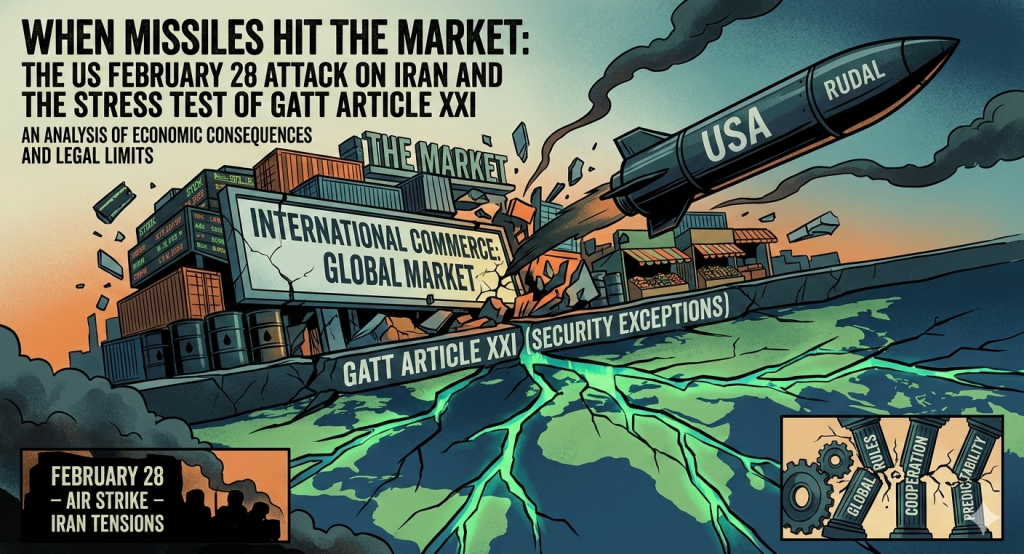
Global security and international economic stability faced a defining crossroads on February 28, 2026. The launch of a series of coordinated missile strikes by the United States and Israel against Iran, officially named Operation Epic Fury, was not merely a kinetic military maneuver but a “black swan” event that shook the foundations of multilateral trade law. As explosions were reported in Tehran, Isfahan, and Bushehr, the impacts were immediately felt from the trading floors in London to crypto exchanges in Asia and the courtrooms of the World Trade Organization (WTO) in Geneva.
This essay explores the mechanisms of this crisis in depth, dissecting how Washington’s unilaterally declared national security interests collided with the market openness commitments governed by Article XXI of the General Agreement on Tariffs and Trade (GATT) 1994. Through a detailed analysis of the attack’s chronology, energy market reactions, and the legal debate surrounding the “Security Exception,” this report demonstrates that the world is witnessing a paradigm shift from rules-based trade toward an era of geo-economic confrontation where militarism and protectionism have become inseparable.
Anatomy of the Crisis: Escalation Toward Operation Epic Fury
The tensions that culminated in the February 28, 2026, strikes did not occur in a vacuum. They were the result of a rapid degradation of diplomatic relations since late 2025. The primary domestic trigger in Iran was a brutal crackdown on nationwide protests sparked by economic collapse and political dissatisfaction. By late January 2026, it was estimated that between 32,000 and 36,500 civilians had been killed in clashes with Iranian security forces—a figure confirmed by senior officials within Iran’s own health ministry.
U.S. President Donald Trump capitalized on this situation by adopting a highly assertive public posture. On January 13, 2026, he openly urged the Iranian people to “take over your institutions” and promised that “help is on its way.” Tehran viewed these statements as a blatant violation of national sovereignty and the principle of non-intervention enshrined in the UN Charter.
The Failure of Diplomacy in Geneva
The final attempt to avoid military conflict took place during a third round of nuclear negotiations in Geneva on February 17, 2026. The United States, represented by a hardline negotiating team, presented demands that Iran viewed as a total surrender:
- Complete dismantling of the Fordow, Natanz, and Esfahan nuclear facilities.
- Surrender of all enriched uranium stockpiles to the United States.
- A permanent agreement without “sunset clauses” that also included restrictions on ballistic missiles.
Iran rejected these demands, despite offering incentives such as investments in oil and gas reserves to soften Trump’s stance. The failure of these negotiations was immediately followed by a massive naval deployment, including Carrier Strike Groups 3 and 12, which Trump described as an “armada” heading toward the Middle East.
Execution of the Strikes: February 28, 2026
On the morning of February 28, the world was stunned by a video announcement from Trump on the Truth Social platform. He declared that “major combat operations” were underway to destroy Iran’s nuclear and naval infrastructure.
| Primary Targets of Operation Epic Fury | Action Description | Reported Impact |
| Supreme Leader’s Compound, Tehran | Direct missile strike on Ali Khamenei’s office area. | Heavy damage to command and control centers. |
| Khojir Missile Production Complex | Precision bombing of ballistic missile production facilities. | Destruction of launch systems and manufacturing infrastructure. |
| Port of Bushehr | Attacks on naval bases and nuclear facilities. | Partial paralysis of the Iranian naval fleet. |
| IRGC Facilities in Jurf al-Sakhar | Strikes against Iranian proxies outside its sovereign territory. | Death of thousands of Revolutionary Guard personnel. |
This operation was not a limited aerial strike like “Operation Midnight Hammer” in June 2025; it was a systemic campaign aimed at regime change. Trump issued an ultimatum to Iranian security forces: lay down your weapons for immunity, or face “certain death.”
Market Shocks: Economic Resonance of the Missile Strikes
The market reaction to the February 28 strikes occurred with unprecedented speed, fueled by 24/7 digital asset trading. Bitcoin (BTC) and XRP experienced sharp declines immediately after reports of explosions in Tehran began to circulate. A 3.1% drop in the price of Bitcoin to $63,561 was seen as an early indicator of investor panic that would ripple through traditional equity markets the following Monday.
Defense Sector as a “Subscription Economy”
While general markets slumped, defense sector stocks gained momentum. This event highlighted a structural shift in the global defense industry. Market analysts noted that companies like Lockheed Martin no longer just sell military hardware as one-time transactions. Instead, they manage technological ecosystems that require ongoing maintenance contracts, software support, and continuous modernization.
In the context of Operation Epic Fury, the use of F-22 stealth fighters and F-35 jets to neutralize Iranian air defenses ensures long-term revenue streams for defense contractors. This reframes investment from short-term conflict trading to a long-duration cash-flow business.
Energy Crisis and the Strait of Hormuz Risk
Global oil supply reached its most vulnerable position since the 2022 invasion of Ukraine. Brent Crude settled at $72.48 per barrel on the day of the attack, with war risk premiums beginning to climb.
| Energy Market Metrics (Feb 28, 2026) | Value/Status | Strategic Implications |
| Brent Crude Price | $72.48 (Projected rise to $80+) | Inflationary pressure on oil-importing nations. |
| Strait of Hormuz Traffic | One-way flow OUT | Physical risk of total blockade for 20% of world consumption. |
| War Risk Insurance Premium | Rose from 0.01% to 1.0% | Increased global maritime logistics costs. |
| Alternative Pipeline Capacity | 2.6 – 4.2 million bpd | Insufficient to cover the 20 million bpd needed if the strait closes. |
The Strait of Hormuz, with navigation channels only two miles wide at certain points, serves as a strategic lever for Iran. While a total closure would harm Iran’s own economy, its ability to increase navigational risk through asymmetric methods—such as Chinese-made EM-52 mines and surveillance drones—is enough to trigger price spikes that could cripple the global economy. For nations like India and China, which rely heavily on oil from Iraq, Saudi Arabia, and the UAE passing through the strait, this disruption is an existential threat to their national industries.
Legal Stress Test: GATT Article XXI and the Limits of Sovereignty
Beneath the military and market dynamics lies a profound legal battle over the architecture of world trade. At the heart of the debate is Article XXI of GATT 1994, often called the “Security Exception.” For over 70 years, this article was rarely invoked because WTO members understood that its abuse could destroy the multilateral trading system.
However, the U.S. strikes on Iran and accompanying tariff policies have forced the WTO into a stricter interpretative role. The United States maintains that Article XXI is “self-judging,” meaning every nation has the prerogative to determine what constitutes a security threat without intervention from international judicial bodies.
Legal Precedent: From Russia to U.S. Steel
A major shift in trade law occurred in 2019 with the Russia – Traffic in Transit case. For the first time, a WTO panel rejected the claim that Article XXI was non-justiciable. The panel ruled that while a nation may decide what measures it considers “necessary,” the panel has inherent jurisdiction to objectively review whether the conditions listed in subparagraphs (i) through (iii) of Article XXI(b) are actually met.
The 2022 United States – Steel and Aluminum case reinforced this position. The panel ruled that tariffs imposed by the Trump administration in 2018 were not justified under Article XXI(b)(iii) because global excess capacity did not reach the level of gravity required for an “emergency in international relations.” This ruling is vital to the 2026 crisis because it established a “gravity test” for any state claiming a security exception.
Analysis of the 2026 International Emergency Criteria
To validate combat actions and tariffs against Iran under Article XXI(b)(iii), a future WTO panel would review the following elements:
| Objective Criteria | Facts of the 2026 Iran Crisis | Legal Analysis |
| Existence of War or Emergency | Direct armed conflict and major fleet deployment. | Meets the gravity criteria established in the Russia precedent. |
| Temporal Relationship | Action taken while missiles were launched. | Meets the “taken in time of” requirement. |
| Essential Security Interests | Protection against nuclear and ballistic threats. | Within state discretion but must be clearly articulated. |
| Good Faith Obligation | Claimed defense of protesters vs. energy protectionism. | The most critical point; is security being used as a cloak for protectionism? |
A Chorus of Dissent: Critical Perspectives and Legal Challenges
The 2026 operation has drawn fierce criticism from legal scholars, strategic analysts, and international bodies, who argue that the U.S. actions represent a dangerous departure from international norms.
Critiques of International Law Violations
Legal experts have pointed out that Operation Epic Fury may constitute a breach of the UN Charter, specifically Article 2(4), which prohibits the threat or use of force against the territorial integrity or political independence of any state. Critics argue that:
- Contested Self-Defense: Absent an “imminent threat of armed attack” from Iran, preemptive strikes are legally contested and risk weakening the global legal order.
- Lack of Authorization: The strikes were carried out without UN Security Council authorization, making the claim of “humanitarian intervention” to protect protesters legally controversial and rejected by most states.
- Constitutional Overreach: Within the U.S., critics and lawmakers have condemned the initiation of “major combat operations” without prior Congressional approval, challenging the President’s authority under Article II of the Constitution.
Strategic and Humanitarian Criticisms
Strategic analysts warn that military force is an “imperfect and legally constrained tool” for achieving political change. Key criticisms include:
- Consolidation of the Regime: Experts argue that strikes are likely to consolidate elite cohesion around the Iranian regime and reinforce Tehran’s narrative of being under an external siege, potentially marginalizing the very protesters the U.S. claims to support.
- Historical Trauma: Interventionists are reminded of the 1953 coup; many Iranians remain cautious of U.S. interference, viewing it through a lens where external intervention produced dictatorship rather than democracy.
- Risk of Regional Chaos: Critics point to past interventions in Iraq and Syria as evidence that hollowing out a state often empowers the most organized and militarized domestic parties, leading to long-term instability.
Institutional Critiques of Trade Abuse
The use of “national security” as a justification for 25% universal tariffs has been slammed as “rank protectionism.” The Council on Foreign Relations and other trade observers argue that the U.S. is “abusing” the security exception to erect trade barriers, effectively “neutering” the WTO. China and other trading partners have criticized these measures as a “blatant violation” of the Most-Favored-Nation (MFN) principle and an erosion of the rules-based system. Scholars maintain that re-labeling trade interests as “essential security interests” is a misuse of Article XXI and violates the principle of “Good Faith” in treaty performance.
WTO in Critical Condition: Paralysis of the Dispute Settlement System
The greatest threat to global trade law is not the lack of rules, but the lack of an enforcement mechanism. Since late 2019, the WTO Appellate Body has been non-functional because the United States continues to block the appointment of new judges.
This has created a legal stalemate where a country that loses a panel ruling can appeal “into the void.” Since the appeal cannot be resolved without judges, the panel report never becomes final or legally binding. This strategy allows the United States to technically claim compliance with international rules while practically ignoring any adverse rulings.
The Rise of Protectionism via Security Notifications
Lack of judicial oversight has triggered an alarming global trend. Nations are following the U.S. lead by using “national security” labels to justify trade barriers on goods entirely unrelated to the military.
According to reports, national security notifications at the WTO reached a record high of 95 in 2024 and are expected to surge further post-2026. This phenomenon includes:
- Export restrictions on food in the name of “food sovereignty.”
- High tariffs on tech products due to “cyber espionage” fears.
- Bans on foreign investment in energy infrastructure for “national resilience.”
Regional Impact: The Middle East Amidst Fire and Integration
The 2026 crisis places extreme pressure on the Gulf Cooperation Council (GCC) states. On one hand, Saudi Arabia and the UAE are pursuing economic diversification through giant projects like the GCC Railway and the India-Middle East-Europe Economic Corridor (IMEC). On the other hand, they are on the front lines if Iran retaliates against U.S. bases hosted in their territories.
Connectivity vs. Geopolitical Fragmentation
GCC efforts to become a global logistics hub—connecting Asia and Europe via land infrastructure and undersea cables—are threatened by prolonged instability. The IMEC project, aimed at bypassing the Red Sea and minimizing dependence on China, faces challenges from the risk of missile attacks on the planned railway network.
However, the crisis has also accelerated internal integration. The planned King Hamad Causeway between Bahrain and Saudi Arabia and the expansion of airport capacities show a push for an economic corridor resilient to external shocks. China, strengthening ties with the Gulf, is positioning itself as an economic counterbalance to U.S. military dominance in the region.
Future Risk Analysis: Supply Chains and Cybersecurity
Operation Epic Fury also marks a new chapter in hybrid warfare. Alongside physical strikes, 2026 has seen a surge in cyberattacks targeting global supply chains. Reports indicate that 80-90% of modern attack operations are now automated by AI agents.
In the context of the Iran conflict, attacks on energy infrastructure are no longer just about physical sabotage of pipelines but about compromising Industrial Control Systems (SCADA) through identity and API breaches. “Cyber resilience” is now considered as vital as traditional military deterrence in maintaining international trade.
Synthesis and Recommendations: Navigating a New Order
The February 28, 2026, strikes have permanently altered the relationship between state sovereignty and free markets. The conclusions of this analysis highlight several critical points:
- The Death of Trade Neutrality: GATT Article XXI has shifted from a rarely used exception to a primary tool of coercive diplomacy. Without structural reform at the WTO, “national security” will continue to serve as a pretext for protectionism, further fragmenting global trade.
- Shifting Energy Dynamics: Global dependence on the Strait of Hormuz remains an unresolved structural weakness. While alternative routes exist, their capacity is far from sufficient to stabilize prices in a total conflict scenario.
- The Need for Judicial Certainty: Restoring the WTO Appellate Body is a necessity to prevent the world from sliding into an endless trade war. Alternatives like the Multi-Party Interim Appeal Arbitration Arrangement (MPIA) can serve as a bridge, but their effectiveness is limited without U.S. participation.
- Resilience of Economic Corridors: Projects like IMEC and the GCC Railway must integrate physical and cyber security into their infrastructure design. Economic sustainability in the Middle East is now inseparable from regional geopolitical stability.
Ultimately, the events of February 28, 2026, serve as a stark warning that global prosperity cannot be built on foundations vulnerable to the volatility of great power politics. As missiles hit the markets, the world lost not only price stability but the legal certainty that has kept the peace through trade for nearly eight decades.