The Interregnum of the International Order
The global institutional framework, a sophisticated architecture of treaties, norms, and adjudicatory bodies established in the wake of the mid-twentieth century’s total wars, is currently undergoing a process of terminal fragmentation. This collapse is not the result of a single catastrophic failure but is rather the culmination of decades of incremental normative decay, now accelerated by the explosive military confrontation between the United States, Israel, and the Islamic Republic of Iran in early 2026. At the heart of this crisis lies the systematic dismantling of the United Nations Charter, the weaponization of international trade law, and the paralysis of the multilateral trading system. The commencement of Operation Epic Fury on February 28, 2026, serves as the definitive punctuation mark in this transition from a rules-based international order (RBIO) to a world defined by raw power, unilateral coercion, and the erosion of sovereign equality.
As the twenty-first century progresses, the foundational premise of the UN Charter—the prohibition of the unilateral use of force as enshrined in Article 2(4)—is being replaced by an “elastic” interpretation of self-defense that threatens to render the principle of non-intervention obsolete. This legal volatility is mirrored in the economic sphere, where the World Trade Organization (WTO) has seen its “crown jewel,” the Dispute Settlement Understanding (DSU), effectively neutralized by a persistent blockade of its Appellate Body. The ensuing vacuum has empowered the United States to deploy secondary sanctions and national security exceptions as blunt instruments of foreign policy, triggering a global retreat into mercantilism and regional trade blocs. The de facto closure of the Strait of Hormuz in March 2026, resulting from Iranian retaliation against US-Israeli strikes, has further exposed the fragility of global supply chains, pushing energy prices toward record highs and forcing major economies like China and India to reassess their strategic dependencies.
The Genealogy of Nuclear Diplomacy: The Rise and Fall of the JCPOA
The current military conflagration is deeply rooted in the failure of the 2015 Joint Comprehensive Plan of Action (JCPOA), a landmark diplomatic effort that attempted to manage the symptoms of the Iran-West conflict without resolving its underlying ideological and geopolitical causes. Negotiated by the P5+1—the five permanent members of the UN Security Council plus Germany—and the European Union, the JCPOA sought to unwind Iran’s nuclear program to a point where a “breakout” to a weapon would take at least one year. In exchange for these restrictions, Iran was promised relief from the international sanctions that had devastated its economy. However, the agreement was built on a fragile political foundation. In the United States, the Obama administration viewed the deal as the best available option to avoid another Middle Eastern war, while domestic critics and regional allies like Israel and Saudi Arabia argued that it was too conciliatory and ignored Iran’s ballistic missile program and its network of regional proxies.
The inherent structural weaknesses of the JCPOA became apparent when the United States, under the Trump administration, announced its unilateral withdrawal on May 8, 2018. Because the JCPOA was an “agreement” or a “plan of action” rather than a formal treaty ratified by the US Senate, it possessed no formal provisions for withdrawal, allowing any signatory to cease compliance at will. The US decision to reimpose “maximum pressure” sanctions was intended to coerce Tehran into a more comprehensive deal, but it instead vindicated hard-liners within the Iranian regime, such as Ebrahim Raisi, and led Iran to gradually exceed the uranium enrichment limits starting in May 2019. By early 2021, Iran’s stockpile was more than 12 times the permitted level, and by early 2023, the enrichment level had reached 20 percent—well beyond the 3.67 percent cap.
Comparative Framework of the JCPOA Provisions and Breaches
| Provision Category | JCPOA Original Terms (2015) | Post-2018 Escalation Status |
| Uranium Enrichment Cap | 3.67% purity. | Reached 20% by 2021; exceeded thereafter. |
| Uranium Stockpile Limit | 300 kg (98% reduction). | Exceeded limits by 12x by 2021. |
| Breakout Timeline | Minimum 1 year. | Estimated at a few months or less by 2024. |
| Monitoring/IAEA Access | Continuous transparency/inspections. | Reduced access/cooperation following US withdrawal. |
| Sanctions Relief | Broad relief from nuclear-related measures. | Reimposition of US primary and secondary sanctions. |
The subsequent Biden administration expressed a willingness to return to the JCPOA, but more than two years of stop-and-go talks failed to produce a compromise. By late 2023, many of the agreement’s key provisions began to expire, including the snapback mechanism for UN sanctions, which was set to expire in October 2025. This deadline created a sense of “artificial urgency,” pushing the international community toward the 2026 flashpoint. The failure of atomic diplomacy demonstrated that in the absence of a binding legal framework, geopolitical shifts in any one signatory state could derail decades of multilateral progress, leaving the international community with the binary choice between an imperfect deal and a regional war.
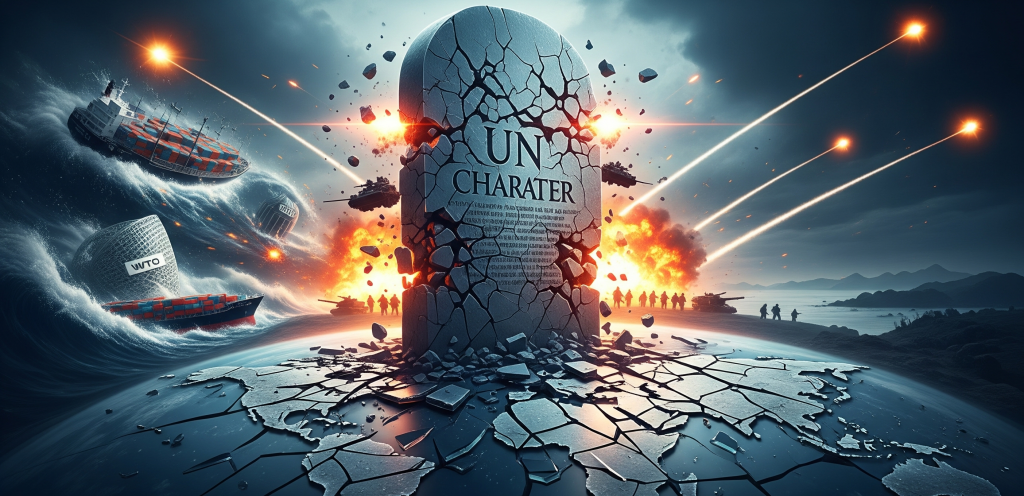
Operation Epic Fury and the Death of the UN Charter
The commencement of major airstrikes across Iran on February 28, 2026, known as Operation Epic Fury, represents the most significant challenge to the UN Charter’s prohibition on the use of force in the twenty-first century. Launched jointly by the United States and Israel, the operation was framed by President Trump as a moral necessity to dismantle Iran’s missile capabilities, degrade its naval assets, and ensure that the regime could never threaten the world with a nuclear weapon. However, the strikes were conducted without the authorization of the UN Security Council, leading UN Secretary-General António Guterres to condemn the actions as a violation of the Charter that risked igniting a chain of events beyond anyone’s control.
The legal justification provided by the United States relies on a controversial expansion of Article 51 of the UN Charter, which recognizes the “inherent right” of individual or collective self-defense. Ambassador Mike Waltz, speaking at an emergency Security Council briefing, argued that Iran had engaged in a series of unprovoked armed attacks targeting the US and its allies, including attempts to assassinate US officials and the targeting of shipping in the Red Sea. Waltz asserted that the US actions were consistent with international law as a response to ongoing aggression. This argument, however, creates a normative “gap” between the consensus of international lawyers and the political justifications of states. While Article 51 has traditionally been limited to responding to actual or imminent armed attacks, the US-Israeli strikes were largely pre-emptive, aimed at degrading capabilities rather than repelling a specific, immediate strike.
The Normative Fragmentation of the Charter
The 2026 conflict illustrates a profound crisis in the interpretation of foundational international norms. We are witnessing a shift toward what scholars call the “illegal but legitimate” framework, where violations of the UN Charter are justified on ethical or security grounds. This framework suggests that the legal prohibition on force may be bypassed if a state can convincingly argue that its actions serve the broader interest of global security or human rights, such as preventing a “rogue” state from obtaining nuclear weapons. However, this elasticity undermines the principle of sovereign equality enshrined in Article 2 of the Charter.
The crisis is further complicated by the perspective of Third World Approaches to International Law (TWAIL), which views the normalization of unilateral force as an asymmetrical discipline. From this viewpoint, international law is transforming into a tool where compliance is required for the weak but discretionary for the powerful. The January 2026 military operation in Venezuela—where US forces captured President Nicolas Maduro—served as a precursor to the Iranian strikes, establishing a pattern where the “rules-based order” is interpreted as a “might-makes-right” order. This normalization of the “exception” leads to a collapse of legality into mere discretion for powerful actors, threatening the structural integrity of the UN as an institution.
| UN Charter Principle | Traditional Interpretation | Post-2026 Application (Epic Fury) |
| Sovereign Equality (Art. 2) | All states are legally equal and supreme in their territory. | Sovereignty is contingent on “moral clarity” and regime behavior. |
| Prohibition of Force (Art. 2.4) | Absolute ban except for self-defense or UNSC authorization. | Force is a tool of “regime change” and “capability degradation”. |
| Self-Defense (Art. 51) | Reactive to an armed attack or imminent threat. | Pre-emptive action against “mounting danger” and proxy networks. |
| Non-Intervention | Prohibition of interference in domestic political systems. | US-led “temporary governance” and “facilitation of transition”. |
The humanitarian impact of these strikes has been profound, with reports of civilian casualties, including sixty students killed in an airstrike on a school in Minab. These casualties, combined with the destruction of energy infrastructure and medical centers, raise critical questions regarding the principles of necessity and proportionality under jus in bello (the law of war). The synergistic impact of military action and long-standing unilateral sanctions has created a humanitarian catastrophe that many states, particularly in the Global South, view as a gross violation of peremptory norms of international law (jus cogens).
The Crisis of International Trade Law: The WTO in Ruins
Parallel to the disintegration of the collective security system is the paralysis of the multilateral trading system. The World Trade Organization (WTO), once the apex of global trade governance, is currently facing an existential threat. The United States has fundamentally altered its relationship with the WTO, shifting from being its primary architect to its most significant disruptor. This shift is characterized by three major policies: the blockade of the Appellate Body, the use of Section 301 tariffs, and the expansive invocation of the Article XXI national security exception.
The Blockade of the Appellate Body and the Return to Power-Based Bargaining
Since the creation of the WTO, the Dispute Settlement Body (DSB) was designed to ensure that trade disputes were resolved through legal argument rather than market power. However, the US blockade on the appointment of new Appellate Body members has effectively shut down the system. Without an appeals process, any member can “appeal into the void,” preventing a panel ruling from becoming legally binding. This systemic shutdown has forced countries out of the multilateral framework and into a state of “mini-trade wars,” where unilateral retaliatory actions become the only means of enforcement.
This departure from enforcement norms is devastating because it changes the beliefs of national leaders. If abiding by the DSU is no longer seen as mandatory or beneficial, the political cost of returning to a rules-based system increases. The value of WTO agreements now depends on a country’s relative power to enforce its own interpretation of the rules, creating significant uncertainty for private industries and long-term investments.
Section 301 and the Normalization of Unilateralism
The US has increasingly relied on Section 301 of the Trade Act of 1974 to impose unilateral tariffs on foreign nations it deems to engage in unfair trade practices. This provision allows the US to investigate, negotiate, and sanction foreign countries without requiring WTO approval. In 2018, the US used Section 301 to impose tariffs on $250 billion of Chinese goods, marking the first time such sanctions were applied outside the multilateral framework since the WTO’s inception. China’s response—immediate and unilateral counter-retaliation—violated the core prohibition on trade wars and bypassed the WTO’s role in determining the appropriate level of remedy.
The Article XXI “Black Hole”
The most controversial tool in the current trade conflict is the invocation of GATT Article XXI, the “essential security” exception. Article XXI allows a member to take any action it “considers necessary” for the protection of its essential security interests during a “time of war or other emergency in international relations”. For decades, this provision was a “constructive ambiguity,” rarely used in order to avoid undermining the trading system. However, the US has recently invoked it to justify tariffs on steel, aluminum, and even origin-marking requirements for goods from Hong Kong.
The US maintains that national security issues are “political matters” beyond the reach of WTO dispute settlement. In contrast, WTO panels have begun to assert jurisdiction, ruling that they must objectively assess whether a legitimate emergency exists. In late 2022, panels rejected the US invocation of Article XXI in several disputes, including those brought by China, Norway, and Switzerland. The US responded by appealing these reports into the void, further accelerating the institution’s decline.
| WTO Dispute Settlement Mechanism | Rule-Based System (Pre-2018) | Power-Based System (2026) |
| Appellate Body Status | Functioning; binding appeals. | Blockaded; non-functional. |
| Retaliation Rules | Authorized by WTO only. | Unilateral “mini-trade wars”. |
| Security Exceptions | Used as last resort. | Pervasive “political” justification. |
| Case Outcomes | Near-perfect compliance. | Rulings appealed “into the void”. |
The Geo-economic Impact of Secondary Sanctions
The US-Iran conflict has also highlighted the terrifying potency of secondary sanctions—a relatively new tool that extends the reach of US domestic policy to third-party entities and individuals. While primary sanctions prohibit US persons from trading with a target, secondary sanctions force foreign firms to choose between the Iranian market and the lucrative US financial and consumer markets. This “choice” is effectively an ultimatum, as few global firms can afford exclusion from the US financial system.
Extraterritoriality and the Erosion of Trust
Secondary sanctions raise deep legitimacy questions because they limit the sovereignty of third states to conduct their own external economic relations. The US Office of Foreign Assets Control (OFAC) has imposed massive fines on foreign firms—often with little transparency or allowance for appeal—causing “over-compliance” where banks and companies avoid even humanitarian trade with Iran out of fear. This global enforcement mechanism erodes institutional trust and legal predictability, turning the US dollar from a global utility into a weapon of statecraft.
The Failure of Countermeasures: The EU Blocking Statute and INSTEX
In an attempt to shield their operators, the European Union updated its “Blocking Statute” (Regulation 2271/96) in 2018 to nullify the effect of US secondary sanctions within the EU. The statute prohibits EU companies from complying with US sanctions and allows them to recover damages caused by their application. However, the statute has been largely ineffective. Companies must decide on a “basis of their assessment of the economic situation,” which often leads them to withdraw from Iran to protect their global interests. The lack of centralized enforcement within the EU further weakens the statute, as member states take diverging approaches to its implementation.
Similarly, the creation of INSTEX (Instrument in Support of Trade Exchanges)—a barter system designed to facilitate payments without using the US banking system—was a failure. Used only once, it was dissolved in 2023. The system was intended to preserve the JCPOA by maintaining legitimate trade, but it ultimately lacked the scale and political backing required to bypass the dominance of the US dollar. The dissolution of INSTEX signaled to Tehran that Europe was unable or unwilling to offer a real alternative to the US financial siege.
Operation Epic Fury: The Military Tipping Point
The strikes that began on February 28, 2026, were of a scale and intensity far exceeding the previous “12-Day War” of 2025. Operation Epic Fury (also referred to in some legal circles as Roaring Lion) targeted over 300 locations across Iran, including the Supreme Leader’s residence, IRGC command centers, and critical missile production facilities. Reports emerging in early March suggest that the Iranian leadership has been severely degraded, with the confirmed deaths of IRGC Commander Mohammed Pakpour and Defense Minister Amir Nasirzadeh. Unconfirmed reports also suggest that Supreme Leader Ali Khamenei may have been killed, prompting the immediate selection of his son as successor—a move that has further weakened the regime’s legitimacy.
Tactical Objectives and “Regime Change from the Skies”
President Trump has defined the military objectives as “unconditional surrender,” meaning the total annihilation of the Iranian Navy and the complete dismantling of its nuclear and ballistic programs. This “regime change from the skies” approach assumes that intense aerial pressure will force the security establishment to either collapse or switch sides to the opposition. However, experts at Chatham House and other think tanks warn that external military pressure does not automatically build a viable alternative government. Instead, the conflict risks birthing “IRGCistan”—a military-controlled state that could be even more hard-line and unpredictable than the previous clerical regime.
Regional Spillover and Retaliation
Iran’s response to Operation Epic Fury was immediate and geographically expansive. Tehran launched missile and drone strikes not only against Israel but also against Gulf countries that host US military facilities, including Bahrain, Jordan, Kuwait, Qatar, Saudi Arabia, and the UAE. These strikes targeted civilian infrastructure, such as the Ras Tanura oil refinery in Saudi Arabia and the Ras Laffan LNG facilities in Qatar. This strategy aims to drive a wedge between the Gulf monarchies and the United States, making the “cost of alliance” too high for Riyadh and Abu Dhabi.
| Country | Military Action/Impact (March 2026) | Stated Diplomatic Position |
| United States | Launched Operation Epic Fury. | Acts in self-defense under Art. 51. |
| Israel | Joint strikes on Iranian nuclear sites. | Aims to “cast off the yoke” of the regime. |
| Iran | Retaliatory strikes on Gulf neighbors. | Asserts right to self-defense under Art. 51. |
| Saudi Arabia | Ras Tanura refinery hit/shut down. | Calls for dialogue; values good-neighborliness. |
| Qatar | Ras Laffan LNG production halted. | Host to US bases; victim of retaliatory drones. |
| China | 3,000+ citizens evacuated from Iran. | Gravely concerned; rejects use of force. |
| Russia | NSTC railway negotiations frozen. | Condemns strikes as “premeditated aggression”. |
The Maritime Siege: The Strait of Hormuz and Energy Markets
The de facto closure of the Strait of Hormuz has sent shockwaves through the global economy. As the world’s most critical energy chokepoint, the strait carries roughly 25 percent of global seaborne oil and 20 percent of LNG. The Iranian Navy and IRGC have warned all tankers against attempting to cross, effectively bringing traffic to a standstill.
Economic “Heart Attack” and Global Inflation
Analysts have warned that three to four days of disruption is enough for the energy market to have a “heart attack”. Oil prices, which were already elevated, entered a phase of extreme volatility, with projections of crude hitting $130 to $140 per barrel if the disruption lasts longer than a week. This surge in energy costs has triggered renewed inflationary pressure across the global economy, making near-term interest rate cuts unlikely and reducing industrial competitiveness in energy-intensive sectors.
The Vulnerability of India and China
Asia is the primary destination for oil transiting the Strait of Hormuz. India is particularly vulnerable, importing approximately 2.5 to 2.7 million barrels of crude per day through the strait. China, while holding significant crude reserves, faces a similar risk to its energy security. While alternative pipelines exist, such as Saudi Arabia’s East-West pipeline or the UAE’s pipeline to Fujairah, they can only handle about 17 percent of typical flow volumes. This means that the majority of Gulf oil and gas has no alternative means of exiting the region, making the security of the strait a global necessity.
| Chokepoint Metric | Pre-Conflict Baseline | March 2026 Conflict Status |
| Daily Oil Flow | ~20-21 million barrels. | Effectively halted; 4M+ bpd supply drop. |
| LNG Global Share | ~22% of global trade. | Severe disruption; Qatar production zeroed. |
| Tanker Traffic | 3,200 vessels active in Gulf. | Idled or rerouted via Cape of Good Hope. |
| Charter Rates | Standard market rates | 300% spike; massive insurance surcharges. |
| Oil Price (Brent) | ~$75-85/bbl | $100+; projected $130-140/bbl. |
The closure of the strait also has wider logistical consequences. Major container carriers have suspended routes or rerouted vessels around the Cape of Good Hope, adding thousands of kilometers to voyages between Asia and Europe. This increases fuel consumption, extends delivery times, and reduces overall global shipping capacity, compounding the inflationary effects of high oil prices.
Strategic Realignments in a Fragmented World
The 2026 conflict is accelerating the emergence of a multipolar world order where Western-led institutions no longer hold a monopoly on legitimacy. Russia and China, despite their own history of violations, have positioned themselves as the defenders of the UN Charter and the principles of sovereignty.
The Russia-Iran Axis and the NSTC
Russia views the attack on Iran as a direct threat to its own interests. Iran has provided crucial military support to Russia’s war in Ukraine, and the two countries were on the verge of finalizing the “North South Trade Corridor” (NSTC)—a railway link intended to offer a sanctions-free trade route to the Indian Ocean. The destruction of Iranian infrastructure and the potential for regime change remind the Kremlin that no leader is safe from US policy, reinforcing their desire to see the “death knell” of the liberal, rules-based order.
China’s Dilemma: Bulwark vs. Business
China is in a structurally uncomfortable position. On the one hand, Iran is a key “anti-Western bulwark” and a source of deeply discounted oil. On the other hand, Beijing values regional stability and has invested heavily in the Gulf monarchies. The 2026 crisis threatens China’s “Belt and Road” interests and its role as a mediator—a role it successfully showcased in the 2023 Iran-Saudi rapprochement. While China has condemned the US-Israeli strikes, it has also urged all parties to stop military operations to prevent regional turmoil from damaging global economic growth.
The European Divide
Europe is facing its own internal crisis. Leaders are divided between those who prioritize international law and those who support the strategic aims of the United States and Israel. France and Spain have been particularly critical, with President Macron stating that the operations were conducted “outside of international law”. In contrast, Germany, while calling for negotiations, has refrained from passing judgment on the legality of Operation Epic Fury, instead emphasizing the need for a negotiated solution and the rights of the Iranian people to determine their future. This strategic vacuum in Brussels exposes the EU’s inability to act as a cohesive global power in the face of major conflict.
The Future of International Trade Law: From Rules to Power
As we look toward the remainder of 2026, the trajectory of international trade law is one of further erosion. The refusal of the United States to accept WTO panel rulings on national security exceptions signals the end of the WTO as a binding constraint on state action. The likely outcome is a world divided into trade blocs, where the “rule of law” applies only to those without the power to resist.
The Persistence of the National Security Exception
The use of GATT Article XXI is likely to increase as states realize that the WTO can no longer effectively discipline its use. This will lead to a broader interpretation of what constitutes an “emergency in international relations,” allowing states to justify protectionist measures as “essential security” requirements. The “national security” exception, once a rare shield, has become the sword of a new mercantilist era.
The Rise of Alternative Financial Systems
The weaponization of the US dollar through secondary sanctions and the SWIFT system is forcing other powers to accelerate the development of alternative payment mechanisms. While INSTEX failed, the BRICS nations and other emerging economies are likely to invest more heavily in digital currencies and non-dollar clearing systems to protect their economic sovereignty from the extraterritorial reach of OFAC. This fragmentation of the global financial system will reduce transparency and increase the complexity of international trade, further undermining the post-war ideal of a unified global economy.
Synthesis and Conclusion: A World in Ruins
The crisis of 2026 is the final collapse of the “interwar” period—the three decades of relative stability following the end of the Cold War. The ruins of the UN Charter and the WTO are not merely the result of the US-Iran conflict; they are the result of a long-term divergence between the stated ideals of the international community and the actual behavior of its most powerful members.
Nuanced Insights and Actionable Realities
- The Normative Vacuum: The “illegal but legitimate” framework is a dangerous precedent. It allows for the moral justification of violence while destroying the legal constraints that prevent escalation. The 2026 strikes on Iran, even if tactically successful, leave a world without a functional mechanism to prevent the next war.
- Trade as Statecraft: International trade law has been re-absorbed into the realm of high politics. The WTO’s shift from a rule-based system to one of power-based bargaining means that corporate risk management must now prioritize geopolitical alignment over legal compliance.
- The Chokepoint Vulnerability: The closure of the Strait of Hormuz demonstrated that global energy security is a “tail risk” with catastrophic consequences. The inability of the US to guarantee the freedom of navigation without triggering a regional war suggests that the maritime order is as fragile as the legal order.
- The Strategic Realignment: We are entering an era of “asymmetrical discipline,” where the Global South will increasingly seek alternative alliances—with China, Russia, or through regional blocs—to avoid the reach of Western unilateralism.
The international community stands at a crossroads. Without a renewed commitment to the principles of sovereign equality, the non-use of force, and multilateral trade adjudication, the ruins of the 2026 order will not be rebuilt. Instead, they will form the foundation of a more dangerous and fragmented world, where the rule of law is a relic of a bygone era. The transition to this new world order is not coming; it is already here, forged in the fires of Operation Epic Fury and the silence of the WTO’s Appellate Body.
Sources for this article:
- china.usembassy-china.org.cnRemarks at an Emergency UN Security Council Briefing on Iran
- researchbriefings.files.parliament.ukUS-Israel strikes on Iran: February/March 2026 – UK Parliament
- justsecurity.orgThe International Community at a Crossroads Over Iran: The …
- sanctionsplatform.ohchr.orgUnilateral Sanctions: A Violation of Article 2 of the United Nations Charter?
- opiniojuris.orgIf Unilateral Force Becomes Normalized, Who Will be Disciplined …
- scholarship.law.duke.eduCAN INTERNATIONAL TRADE LAW RECOVER? WTO DISPUTE …
- timesofindia.indiatimes.comUS-Iran war sends shockwaves! Most crude via Strait of Hormuz heads to China, India – how vulnerable are they after closure?
- washingtonexaminer.comEnergy markets face ‘heart attack’ as Gulf infrastructure targeted in Iran conflict
- middleeastbriefing.comThe Strait of Hormuz Crisis: Iran Conflict Impact on Oil and Markets – Middle East Briefing
- cfr.orgWhat Is the Iran Nuclear Deal? | Council on Foreign Relations – CFR.org
- britannica.comJoint Comprehensive Plan of Action (JCPOA) | Iran Nuclear Deal, Snapback Sanctions, Summary, Sunset Clauses, Barack Obama, & Donald Trump | Britannica
- en.wikipedia.orgUnited States withdrawal from the Joint Comprehensive Plan of Action – Wikipedia
- rand.orgThe Revenge of the JCPOA – RAND Corporation
- ebsco.comIran Nuclear Agreement: Overview | History | Research Starters – EBSCO
- un.orgMIDDLE EAST LIVE: UN Security Council meeting in emergency session over Iran
- jurist.orgNo Authorization, No Imminence, No Plan: The Iran Strikes and the Rule of Law – JURIST
- securitycouncilreport.orgEmergency Meeting on the Military Escalation in the Middle East – Security Council Report
- usun.usmission.govAdditional Remarks at an Emergency UN Security Council Briefing on Iran
- icj-cij.orgOil Platforms (Islamic Republic of Iran v. United States of America)
- documents.un.orgA/HRC/60/NGO/270 General Assembly – Official Document System – the United Nations
- hinrichfoundation.comTesting the limits of WTO security exceptions – Hinrich Foundation
- taxtmi.comWTO Law vs. U.S. Trade Act Section 301: A Legal and Economic Conflict | TaxTMI
- scholarship.law.duke.eduNote THE AMBIGUITY OF GATT ARTICLE XXI: SUBTLE SUCCESS OR RAMPANT FAILURE?
- digitalcommons.law.umaryland.eduInherent Limits to the World Trade Organization’s Article XXI Self-Judging Security Exception – DigitalCommons@UM Carey Law
- fordhamlawreview.orgcaught in the economic crosshairs: secondary sanctions, blocking regulations, and the american – Fordham Law Review
- ohchr.orgsecondary sanctions:aweapon out of control? the … – OHCHR.org
- docs.un.orgA/HRC/60/NGO/268 General Assembly – the United Nations
- inss.org.ilAn Assessment of the Efforts to Mitigate the Impact of US … – INSS
- finance.ec.europa.euExtraterritoriality (Blocking statute) – Finance – European Commission
- alhaq.orgDEFENDING JUSTICE: HOW THE EU CAN PUSH BACK AGAINST US SANCTIONS ON THE ICC – Al-Haq
- oxfordeconomics.comThe 2026 Iran War, An Initial Take and Implications | Oxford Economics
- atlanticcouncil.orgExperts react: The US and Israel just unleashed a major attack on Iran. What’s next?
- chathamhouse.orgUS and Israel attack Iran, killing Khamenei. Tehran launches counterstrikes: Early analysis from Chatham House experts
- fmprc.gov.cnForeign Ministry Spokesperson Mao Ning’s Regular Press …
- fmprc.gov.cnForeign Ministry Spokesperson Mao Ning’s Regular Press Conference on March 5, 2026
- lowyinstitute.orgWhat the Iran conflict means for Russia
- global.chinadaily.com.cnConflict threatens global shipping and energy markets – Chinadaily …
- ubs.comDaily: US-Iran escalation adds to geopolitical risks | UBS Global
- oxfordeconomics.comIran and the Strait of Hormuz: risks to global energy prices | Oxford Economics
- washingtonexaminer.comWar with Iran will impact oil prices much more than the 1980s crises
- pbs.orgWorld leaders react cautiously to U.S. and Israeli strikes on Iran | PBS News
- cepa.orgRussia, Europe, and the Iran War — CEPA Fellows
- atlanticcouncil.orgExperts react: How the world is responding to the US-Israeli war with Iran – Atlantic Council
- am.jpmorgan.comDoes war in Iran change the 2026 outlook? | J.P. Morgan Asset Management