
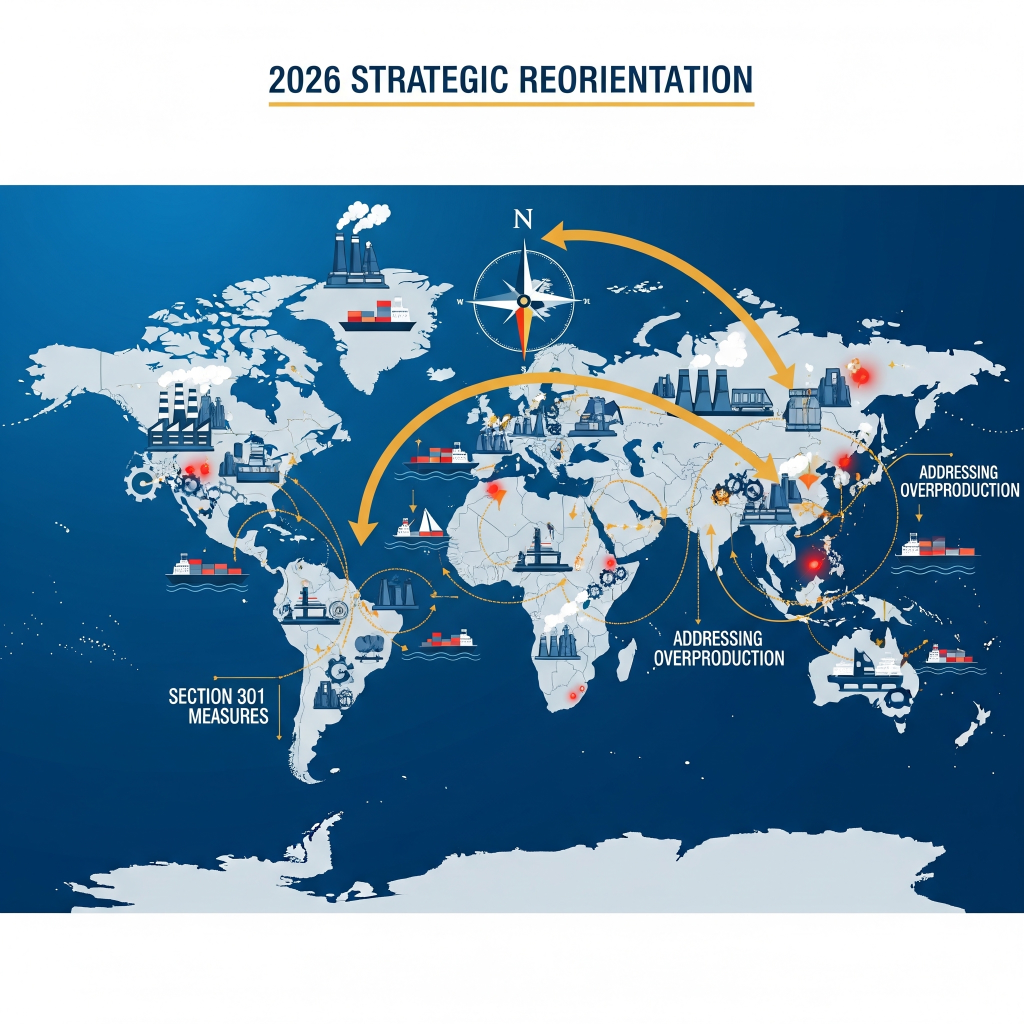
The international trade environment encountered a definitive structural pivot in early 2026, marked by the United States’ transition from broad emergency measures to a sophisticated, sector-specific investigative framework. This shift was precipitated by a complex interplay of judicial oversight, executive mandate, and the exacerbation of long-standing global manufacturing imbalances. At the center of this transformation is the launch of comprehensive investigations under Section 301 of the Trade Act of 1974, targeting 16 major trading partners for policies that foster structural excess capacity and production. Unlike previous trade actions that responded to discrete instances of dumping or subsidies, the 2026 probe seeks to address a systemic phenomenon where production potential has become fundamentally untethered from domestic and global demand. This analysis explores the legal, economic, and geopolitical dimensions of the probe, examining how the United States intends to utilize statutory authority to dismantle the structural trade surpluses that currently burden its domestic industrial base.
The Judicial Catalyst and the Collapse of Emergency Tariff Authority
The immediate genesis of the March 2026 Section 301 investigations lies in the United States Supreme Court’s intervention in the executive branch’s previous tariff program. On February 20, 2026, the Court issued a landmark ruling in Learning Resources, Inc. v. Trump, which invalidated the administration’s use of the International Emergency Economic Powers Act (IEEPA) for the implementation of broad-based tariffs. The Court’s six-to-three decision—joined by three conservative and three liberal justices—emphasized the constitutional separation of powers, specifically noting that the authority to impose taxes and regulate foreign commerce resides with Congress and that IEEPA does not explicitly grant the president the power to set tariff rates.
The invalidation of IEEPA-based tariffs, which had been in effect since January 2025, created a significant revenue and policy vacuum. Analysts estimated that the loss of these duties would reduce federal revenue by approximately $1.7 trillion through 2036, assuming a refund of collected tariffs. Furthermore, the ruling necessitated an immediate cessation of IEEPA tariff collections, which took effect at 12:01 a.m. on February 24, 2026. To maintain trade leverage while developing a more resilient legal justification, the administration pivoted to a two-stage statutory strategy.
Table 1: Comparative Statutory Authorities for U.S. Trade Action (2026)
| Legal Statute | Primary Function | Limitations | Role in 2026 Strategy |
| IEEPA | Address national emergencies by regulating economic transactions. | Invalidated by SCOTUS for tariff-setting; requires “emergency” declaration. | Former primary tool; now used only for non-tariff sanctions. |
| Section 122 | Impose temporary tariffs to address balance-of-payments deficits. | Max 150 days; max 15% rate; requires specific economic conditions. | Immediate stopgap; 10% global tariff implemented Feb 24, 2026, through July 24, 2026. |
| Section 301 | Investigate and remedy “unfair,” “unreasonable,” or “discriminatory” foreign practices. | Requires investigation, public comment, and consultations. | Permanent replacement; sector-specific probes launched March 11, 2026. |
| Section 232 | Adjust imports that threaten national security. | Requires investigation by Department of Commerce. | Complementary tool for specific industrial materials. |
The stopgap measure utilized by the administration was Section 122 of the Trade Act of 1974, which permits a temporary global tariff of up to 15% for a duration of 150 days. The 10% Section 122 tariff, implemented on February 24, 2026, serves as a bridge, set to expire on July 24, 2026. The objective of the March 11 Section 301 launch is to conclude the necessary investigations and establish a new, legally defensible tariff structure before the Section 122 authority lapses.
Statutory Framework and Investigative Mechanisms of Section 301
Section 301 represents one of the most potent tools in the United States’ trade enforcement arsenal, granting the Office of the United States Trade Representative (USTR) broad authority to investigate and remedy foreign trade practices that are deemed “unjustifiable,” “unreasonable,” or “discriminatory”. The 2026 investigations are conducted under Section 301(b), which specifically addresses foreign acts that burden or restrict U.S. commerce. Unlike Section 301(a), which mandates action when a trade agreement is violated, Section 301(b) allows for discretionary action to obtain the elimination of problematic practices.
The current investigation is a self-initiated action by the USTR, a mechanism provided by Section 302(b) of the Trade Act. This self-initiation reflects an assertive industrial policy where the government proactively identifies and challenges systemic market distortions rather than waiting for formal industry petitions. The investigation is overseen by the Section 301 Committee, an inter-agency body that includes representatives from various executive departments, which ensures that trade remedies align with broader economic and national security objectives.
The Investigative Process and Timeline
The statutory process for a Section 301 investigation involves several mandatory phases designed to ensure transparency and provide opportunities for international resolution before tariffs are applied. Upon initiation, the USTR is required to request consultations with the target governments to seek a negotiated settlement. Simultaneously, the agency opens a public record to collect evidence from domestic manufacturers, labor organizations, and other stakeholders regarding the economic burden imposed by the foreign practices under review.
The timeline for the 2026 probe is exceptionally compressed to align with the expiration of the Section 122 bridge tariffs. The USTR announced the probe on March 11, 2026, with public dockets opening on March 17. Written comments and hearing requests are due by April 15, and public hearings are scheduled to begin on May 5 at the U.S. International Trade Commission (USITC). The administration aims to issue its final findings and proposed remedies by late July, ensuring no gap in enforcement coverage.
Table 2: 2026 Section 301 Procedural Calendar
| Phase | Date | Action Item |
| Initiation | March 11, 2026 | USTR formally begins 16 separate investigations. |
| Consultations | March–April 2026 | USTR requests bilateral meetings with target economies. |
| Public Comments | March 17 – April 15, 2026 | Stakeholders submit written evidence and testimony summaries. |
| Public Hearings | May 5 – May 8, 2026 | Oral testimony delivered before the Section 301 Committee at USITC. |
| Rebuttal Period | May 15, 2026 (approx.) | Seven-day window for post-hearing comments. |
| Final Determination | July 2026 | Findings and proposed tariff/non-tariff remedies announced. |
Conceptualizing Structural Excess Capacity and Production
The primary focus of the 2026 investigation is “structural excess capacity,” a concept that distinguishes systemic overproduction from the temporary imbalances typically associated with market cycles. The USTR defines structural excess capacity as under-utilized industrial production capacity that is sustained through governmental interventions or policies that incentivize companies to maintain or grow capacity inefficiently. This phenomenon is particularly damaging because it prevents market forces from correcting oversupply, leading to depressed global prices and the displacement of domestic production in countries that do not provide similar levels of state support.
The USTR identifies several core indicators of structural excess capacity:
- Low Capacity Utilization: Global manufacturing utilization rates have recently fluctuated between 75.0% and 75.9%, well below the 80% threshold considered healthy for industrial sustainability. In the United States, utilization reached a low of 75.2% in late 2024, which the USTR cites as evidence that domestic industry is being suppressed by foreign overproduction.
- Untethered Production: Manufacturing output that is disconnected from domestic consumption or global demand, often fueled by subsidies.
- Persistent Trade Surpluses: The generation of massive goods surpluses as economies “export their problems” with overcapacity to foreign markets.
- Survival of Unprofitable Firms: The persistence of “zombie companies” that are unable to meet interest expenses from operations but remain online due to government backing.
The USTR’s Seven Pillars of Overcapacity
The 2026 probe organizes its investigation around seven distinct types of policy interventions that are believed to create and maintain structural imbalances. These interventions represent a shift in trade policy away from a narrow focus on direct export subsidies toward a broader analysis of internal industrial strategy and labor market regulation.
- Subsidized Production and Export: Financial transfers that decouple investment decisions from market demand.
- Wage Suppression: Policies that artificially depress labor costs, thereby limiting domestic consumption and forcing a reliance on export markets.
- State-Owned Enterprise (SOE) Activity: The use of non-commercial entities to achieve industrial goals without regard for profitability.
- Market Access Barriers: The use of non-tariff barriers to protect domestic markets while simultaneously exporting surpluses abroad.
- Subsidized Lending: Preferential access to capital for specific industrial sectors.
- Currency Practices: Alleged manipulation of exchange rates to maintain export competitiveness.
- Lax Environmental/Labor Enforcement: The use of lower standards as a form of indirect subsidy to manufacturing.
Sectoral Analysis: The Industrial Focal Points of the Probe
The USTR has provided an illustrative list of sectors currently considered “plagued” by excess capacity and production. These sectors are critical to the administration’s “reindustrialization” efforts and include both traditional heavy industry and advanced technological manufacturing.
Table 3: Manufacturing Sectors Targeted in the 2026 Section 301 Investigation
| Category | Primary Targeted Industries | Specific Concerns Cited by USTR |
| Metals & Materials | Steel, Aluminum, Cement, Glass, Non-ferrous metals | Persistent overcapacity in China and India; projected global steel surplus of 721 million metric tons by 2027. |
| Energy & Transport | Automobiles (EV focus), Batteries, Ships, Solar Modules | Chinese EV expansion (BYD) despite falling domestic utilization; India’s solar module capacity tripling domestic demand. |
| Advanced Manufacturing | Semiconductors, Robotics, Satellites, Machine Tools | Strategic dominance efforts in Singapore (semiconductors) and Taiwan (electronics). |
| Industrial Chemicals | Petrochemicals, Plastics, Paper | Massive surpluses in South Korea and China affecting global pricing. |
| Consumer & Food | Processed food and beverages, Electronics | Mexico’s processed manufacturing and Vietnam’s electronics exports. |
The Automotive Sector and the Electric Vehicle (EV) Crisis
A central pillar of the investigation is the automotive industry, specifically the rapid expansion of electric vehicle production in China. The USTR asserts that Chinese EV capacity is “untethered” from national demand, leading to a aggressive export push into global markets. The probe specifically identifies BYD as an example of a firm expanding its overseas footprint—with factories in Uzbekistan, Thailand, Brazil, Hungary, and Turkey—to absorb production that cannot be consumed at home. This expansion is viewed as a direct threat to U.S. attempts to build a domestic EV supply chain under the Inflation Reduction Act.
In addition to China, the automotive policies of Japan and South Korea are under review. The USTR notice highlights that a growing number of Japanese automotive firms are underperforming or unprofitable, yet remain active in the global market. For South Korea, the investigation points to a $56 billion goods and services trade surplus with the U.S. in 2024, driven largely by automobiles and automotive parts.
Steel and the Global Forum on Steel Excess Capacity (GFSEC)
The steel industry remains a primary target for Section 301 action. The USTR notice cites data from the Global Forum on Steel Excess Capacity (GFSEC), which estimates that global steel excess capacity is expected to reach 721 million metric tons by 2027. This excess is attributed to non-market practices that fuel capacity growth in economies where demand is stagnant. The USTR argues that these surpluses put U.S. steel investments at risk, as domestic producers are forced to compete against “artificially cheap” imports.
Solar Modules and Green Technology Imbalances
The green energy transition is another critical arena for the 2026 probe. India’s solar module sector is specifically highlighted, with reports indicating that its manufacturing capacity is triple its annual domestic demand. This imbalance forces Indian manufacturers to seek export markets, primarily the United States, thereby undermining U.S. efforts to re-shore solar manufacturing. The investigation also targets China’s dominance in the solar and battery sectors, which was the subject of an earlier four-year review that resulted in tariff increases on solar cells to 50% in 2024.
Geographic Analysis: The 16 Targeted Economies
The scope of the March 2026 investigation is geographically diverse, targeting 16 major trading partners. This represents a significant escalation from the previous focus on China, signaling that the administration views structural overcapacity as a global phenomenon that requires a multi-country response.
Table 4: Key Targeted Economies and Primary Investigative Concerns (2026)
| Economy | Reported 2024 Trade Surplus with U.S. | Specific Sectoral Concerns | Official Stance/Response |
| China | $1.2 Trillion (Global) | EVs, Batteries, Chemicals, Shipbuilding | Dismissed as “false proposition” and “political manipulation”. |
| European Union | Significant (Germany/Ireland) | Automobiles, Steel, Energy Goods | Vowed “firm and proportionate” response to any breach of 2025 Framework. |
| India | $58 Billion | Solar Modules, Petrochemicals, Steel | Paused trade talks; “wait and watch” approach. |
| South Korea | $56 Billion | Automobiles, Parts, Petrochemicals, Steel | Pledged to protect local exporters while cooperating with U.S.. |
| Singapore | $27 Billion (U.S. Claim) | Semiconductors, Electronics | Disputed U.S. data; claims $27 billion trade deficit instead. |
| Mexico | Significant Surplus | Processed Food & Beverages, Manufacturing | Negotiations tied to upcoming USMCA Joint Review. |
| Cambodia | $12 Billion | Garments, Footwear, Travel Goods (GFT) | Concerns over sourcing delays and factory investment. |
| Japan | Significant Surplus | Automobiles, Machinery, Electronic Devices | Scrutinizing probe details while implementing existing trade deal. |
The Dispute with Singapore: Data Divergence and Methodology
The inclusion of Singapore has sparked a notable controversy regarding trade statistics. The USTR Federal Register Notice values Singapore’s 2024 bilateral trade surplus in goods and services at $27 billion. However, Singapore’s Ministry of Trade and Industry (MTI) has issued a formal rebuttal, stating that official data shows a $27 billion trade deficit with the United States. Furthermore, Singapore maintains that its industrial occupancy remains healthy at 90%, contradicting U.S. claims of underutilized manufacturing space. This disagreement highlights the difficulties in assessing “structural” imbalances when different nations utilize divergent methodologies for calculating trade balances and capacity utilization.
The EU-U.S. Framework and the Risk of Breach
The investigation of the European Union threatens to unravel the United States-European Union Framework on an Agreement on Reciprocal, Fair, and Balanced Trade, which was finalized in August 2025. The EU argues that while it shares U.S. concerns regarding global overcapacity, the sources of such overcapacity lie outside of Europe. European Commission spokesperson Olof Gill indicated that the bloc expects the U.S. to respect the terms of the 2025 deal, which reportedly includes commitments to maintain tariffs at specific rates. Any move by the USTR to impose 301 tariffs on EU goods would be perceived as a breach, likely triggering retaliatory measures.
India and the Suspension of Trade Framework Negotiations
India’s inclusion in the probe has stalled recent bilateral progress. Following the announcement, Indian officials signaled a pause in talks for an interim trade framework, citing the need for clarity on the potential for fresh tariffs. The U.S. investigation specifically targets India’s solar module sector, where manufacturing capacity is reportedly triple domestic demand, and vital export sectors like petrochemicals and textiles. In 2025, India maintained a $58 billion trade surplus with the U.S., a figure the Trump administration views as unsustainable and symptomatic of structural overproduction.
The Parallel Forced Labor Investigation: A Global Audit
In addition to the manufacturing capacity probe, the USTR launched a secondary Section 301 investigation into 60 economies regarding failures to take action on forced labor. This investigation examines whether foreign governments have failed to impose and enforce bans on the importation of goods produced with forced labor, which creates an “artificial cost advantage” that burdens U.S. firms and workers.
The 60 economies subject to this probe include nearly all major U.S. trading partners, ranging from industrialized nations like the EU, Japan, and Canada to developing economies like India, Malaysia, and Mexico. This investigation is designed to expand the protections of Section 307 of the Tariff Act of 1930 and the Uyghur Forced Labor Prevention Act (UFLPA) into a broader global standard. By linking labor standards directly to “unfair trade practices” under Section 301, the administration is effectively using trade tools to drive a “race to the top” in global labor rights.
Table 5: Key Economies in the Forced Labor Section 301 Probe (Illustrative)
| Region | Sample Investigated Economies | Primary Investigative Focus |
| North America | Canada, Mexico | Enforcement of USMCA labor provisions. |
| Europe | European Union, Norway, Switzerland | Consistency of import bans with international consensus. |
| Asia-Pacific | China, India, Japan, Malaysia, Vietnam, Australia | Supply chain transparency; impact of forced labor on cost structures. |
| Middle East/Africa | Iraq, Israel, Kuwait, Nigeria, Egypt | Regulatory frameworks for prohibiting forced labor imports. |
| Latin America | Argentina, Brazil, Colombia, Peru | Effectiveness of domestic enforcement measures. |
Economic Consequences and Industry Impacts
The launch of the Section 301 investigations has immediate and long-term implications for domestic manufacturing and global supply chains. The USTR argues that foreign overcapacity “displaces” U.S. production and prevents the “investment and expansion” that would otherwise occur if market signals were respected.
Displacement of Domestic Investment
A central argument in the USTR filing is that the mere existence of foreign structural overcapacity acts as a deterrent to domestic investment. When foreign governments provide subsidies that allow their firms to remain operational regardless of global demand, U.S. firms are hesitant to bring new capacity online, fearing that they will be undercut by artificially low prices. This “investment inhibition” is cited as a major hurdle to the administration’s goal of re-shoring critical supply chains in semiconductors, batteries, and advanced electronics.
Corporate Strategy: Stanley Black & Decker Case Study
The shift in U.S. trade policy is already forcing major corporations to reconfigure their supply chains. For example, the world’s largest toolmaker, Stanley Black & Decker, announced plans to reduce its supply sourced from China from roughly 15% in 2024 to less than 5% by the end of 2026. This move is a direct response to the increasing “volatility and risk” associated with tariff uncertainty and the U.S. push for diversified, resilient sourcing. Other firms are similarly “hedging” against potential trade measures by diversifying orders across multiple countries, as seen in the Cambodian garment sector.
Impact on Global Shipping and Commodity Markets
The 2026 probe arrives during a period of significant disruption in global shipping and commodity markets. Escalating conflict in the Middle East has already impacted 40% of the global LPG supply and led to the effective blockade of the Strait of Hormuz. Traders in the agricultural and industrial sectors warn that the new Section 301 probes create a “broader policy overhang” that could exacerbate freight inflation and supply chain bottlenecks. The potential for new tariffs on key sustainable aviation fuel feedstocks and vegetable oils from the EU, Indonesia, and Malaysia could also disrupt the “Farm-to-Fuel” economics of the green energy transition.
Comparative Analysis: Section 301 in 2026 vs. Prior Administrations
While Section 301 has been utilized by previous administrations, the 2026 investigations represent an evolution in both scope and intent. During the first Trump administration, Section 301 was used to target Chinese intellectual property theft and forced technology transfer, leading to tariffs on hundreds of billions of dollars in Chinese goods. The Biden administration maintained most of these tariffs and expanded them in strategic sectors like semiconductors and magnets after a four-year statutory review.
In contrast, the 2026 probe is broader in two ways:
- Geographic Scope: It moves beyond China to target 15 other economies, including major allies and regional partners.
- Thematic Scope: It shifts the focus from “technology theft” to “structural overproduction” and “forced labor enforcement”.
This suggests a “normalization” of Section 301 as a permanent tool for global industrial management rather than a temporary instrument for bilateral negotiations.
Table 6: Evolution of Section 301 Enforcement (2018–2026)
| Period | Primary Targets | Core Investigation Theme | Key Outcomes |
| 2018–2019 | China | IP theft; forced technology transfer. | Implementation of “List 1-4” tariffs on $300B+ of goods. |
| 2022–2024 | China | Statutory Four-Year Review; Shipbuilding sector. | Targeted tariff increases on solar, batteries, and EVs (up to 50-100%). |
| 2026 | 16 Economies (Global) | Structural excess capacity; forced labor. | Rebuilding tariff architecture after SCOTUS IEEPA ruling. |
The Role of International Organizations and Global Reactions
The 2026 U.S. trade actions have met with strong criticism from international bodies and trading partners, who argue that unilateral Section 301 investigations violate the principles of the World Trade Organization (WTO). China’s Ministry of Commerce has noted that a WTO panel previously ruled that tariffs imposed based on Section 301 investigations violate global trade rules. Beijing argues that the U.S. has no right to unilaterally determine what constitutes “overcapacity” or to impose restrictive measures based on its own definitions.
Other partners, while more diplomatic, have signaled their intent to defend their interests. Japan’s Chief Cabinet Secretary Minoru Kihara stated that Tokyo is “scrutinizing” the probe details but intends to continue implementing its existing trade agreement with the U.S.. South Korea’s Blue House and Ministry of Industry have pledged to “work to protect local exporters” from any adverse impacts of the investigation. The EU has similarly vowed to respond “firmly and proportionately” to any breach of the United States-European Union Framework.
Future Outlook: July 2026 and Beyond
As the USTR proceeds with its investigations, the global trade community is focused on the July 24, 2026, deadline. This date marks the expiration of the Section 122 bridge tariffs and the likely implementation of new Section 301 remedies. The outcome of the probe will likely result in one of three conclusions for each targeted economy:
- Finding of Unfair Practices: Mandatory trade restrictions equivalent to the burden on U.S. commerce.
- Finding of Unreasonable/Discriminatory Practices: Discretionary action, subject to presidential direction, to obtain elimination of the practice.
- No Violation: No new trade restrictions applied; current 10% tariffs likely to lapse or be replaced by other measures.
The administration has indicated that the goal is to conclude the investigations and announce “proposed remedies” before the July expiration. This suggests that the summer of 2026 will be a period of intense trade activity, potentially leading to a new global tariff architecture that is grounded in Section 301 authority rather than emergency powers.
Conclusion: Toward a New Trade Consensus
The 2026 Section 301 investigations represent more than a legal maneuver to replace invalidated IEEPA tariffs; they signify a fundamental reimagining of the global trade order. By identifying “structural excess capacity” as a primary threat to national economic security, the United States is challenging the legitimacy of industrial models that rely on state-supported overproduction and export-led growth.
The success of this strategy will depend on the USTR’s ability to substantiate its claims of “unreasonable” practices through a rigorous evidentiary process, as well as the administration’s ability to manage the resulting geopolitical friction. As the world’s largest manufacturing economies prepare for the May hearings, the 2026 probe serves as a definitive statement that the United States is no longer willing to “sacrifice its industrial base” to the systemic imbalances of the global market. The results will determine whether the international community moves toward a new consensus on reciprocal trade or enters a prolonged era of unilateral enforcement and fragmented supply chains.
To protect your business interests in the context of this investigation, read: GLOBAL STRATEGIC ADVISORY: Navigating the 2026 USTR Section 301 Investigations on Structural Excess Capacity
Source for the article:
- bhfs.comUSTR Initiates Section 301 Probe into Structural Excess Capacity and Production in Manufacturing Sectors – Brownstein Hyatt Farber Schreck
- hellenicshippingnews.comUS opens Section 301 trade probes into 16 countries, including EU …
- ustr.govUSTR Initiates Section 301 Investigations Relating to Structural Excess Capacity and Production in Manufacturing Sectors | United States Trade Representative
- ustr.govBilling Code 3390-F4 OFFICE OF THE UNITED STATES TRADE REPRESENTATIVE Docket No. USTR-2026-0067 and USTR-2026-0068 Initiation of
- supplychaindive.comTrump admin probes foreign manufacturing production, capacity …
- prosperousamerica.orgCPA Commends Trump Administration for Launching Section 301 Investigations Targeting Global Manufacturing Overcapacity, Forced Labor
- whitecase.comTrump Administration Imposes 10% Section 122 Tariff in Plan to Replace IEEPA Tariffs
- english.kyodonews.netOPINION: U.S. Supreme Court’s decision on Trump tariffs highlights separation of powers
- crfb.orgHow Much Will Trump’s New 10% (or 15%) Tariffs Raise?-2026-03-04
- bakermckenzie.comUS Supreme Court Ruling Triggers Major Shifts in US Trade Enforcement Strategy
- globaltimes.cnUS Section 301 probe draws opposition from China, risks further …
- cbsnews.comTrump administration takes steps to impose new tariffs, announcing investigations into key trading partners
- globaltradealert.orgAnalysis – Global Trade Alert
- chosun.comU.S. Section 301 Probe Targets South Korea’s Auto, Steel Sectors
- ustr.govFact Sheet: USTR Initiates Section 301 Investigations into Structural Excess Capacity and Production in Manufacturing Sectors
- livemint.comWhat is Section 301 of the Trade Act of 1974? 16 US trading partners including India hit by Trump’s probe
- thompsonhinesmartrade.comUSTR Initiates Section 301 Investigations into the Acts, Policies & Practices of Certain Economies Relating to Structural Excess Capacity and Production in Manufacturing Sector – SmarTrade | Thompson Hine
- kpmg.comUSTR initiates Section 301 investigations on structural excess capacity and production in manufacturing sectors – KPMG
- tvpworld.comEU could face new Trump tarriffs as US opens new unfair-trade probes
- indiatoday.inIndia, China, EU among 16 US trading partners hit by Trump’s ‘301’ tariff probes
- thelogicalindian.comIndia Holds Off On US Trade Talks Pending Clarity on Section 301 Probe
- ustr.govU.S. Trade Representative Katherine Tai to Take Further Action on China Tariffs After Releasing Statutory Four-Year Review – USTR.gov
- americanmanufacturing.orgA Look at the Industrial Overcapacity Problem Has Been a Long …
- theonlinecitizen.comChina dismisses US overcapacity probe as ‘false proposition’ and political pretext
- wtocenter.vnEU warns it will ‘respond firmly’ to any US breach of tariff deal – TTWTO VCCI
- theonlinecitizen.comSingapore disputes US claim of US$27b surplus, says data shows trade deficit amid Section 301 probe
- ustr.govThe United States and Mexico Launch Review Process of the USMCA – USTR
- kiripost.comUS Targets Cambodia in Section 301 Probe, Raising Investor Concerns | Kiripost
- ustr.govUSTR Initiates 60 Section 301 Investigations Relating to Failures to Take Action on Forced Labor
- ustr.govUSTR Releases First-ever Trade Strategy to Combat Forced Labor
- ustr.govAdapting Trade Policy for Supply Chain Resilience: – USTR
- money.rediff.comChina Slams US Trade Probe as Unilateralist Act: Rediff Moneynews