
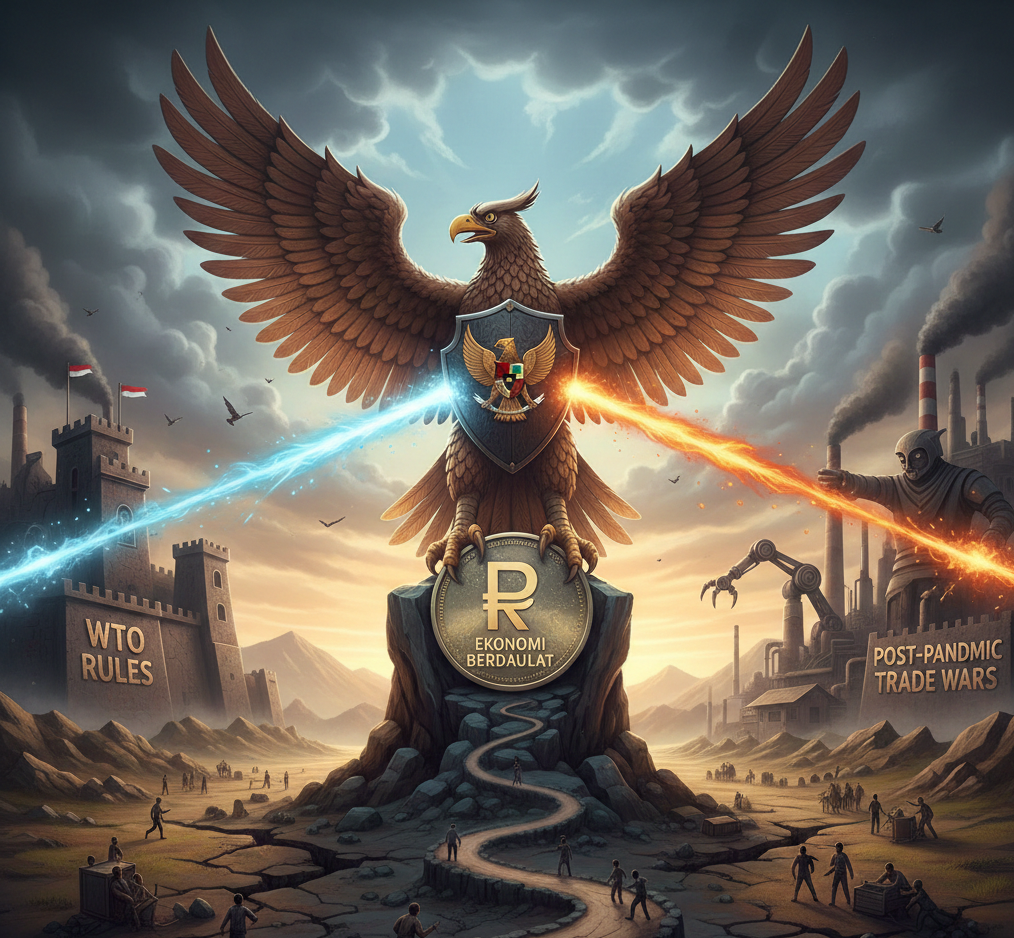
The post-pandemic global order is characterized by a definitive retreat from the unipolar liberal trade regime that dominated the early twenty-first century, replaced instead by a fragmented landscape of geoeconomic competition and securitized supply chains. At the epicenter of this transformation is the Republic of Indonesia, a nation that has transitioned from a passive commodity exporter to a proactive architect of its industrial destiny. This strategic shift is crystallized in the policy of hilirisasi, or downstreaming, a state-led industrial paradigm designed to leverage the country’s massive natural resource endowments—most notably its global lead in nickel reserves—to catalyze a transition into higher-value manufacturing. However, this pursuit of economic sovereignty has not occurred in a vacuum. Rather, it has placed Jakarta at the intersection of a multifaceted crossfire involving the legal strictures of the World Trade Organization (WTO), the intensifying technological and trade rivalry between the United States and China, and a growing internal and external critique regarding the environmental and social costs of “green” industrialization.
The Indonesian narrative is one of a middle-income state attempting to break the structural dependencies inherent in the “resource curse” by mandating domestic processing of critical minerals. This strategy is rooted in a neo-Listian framework that prioritizes the development of national productive capacity over the immediate benefits of free trade. By imposing bans on the export of raw nickel ore, Indonesia seeks to compel multinational corporations to invest in domestic smelting and refining, thereby capturing a larger share of the value chain for stainless steel and electric vehicle (EV) batteries. The outcomes of this policy have been dramatic, with nickel export values surging from 17 trillion Rupiah in 2014 to over 510 trillion Rupiah by 2022, accompanied by a significant influx of foreign direct investment (FDI). Yet, the very success of this “resource nationalism” has triggered a series of external shocks. The European Union’s challenge at the WTO (Case DS592) and the subsequent panel ruling against Indonesia’s export ban have exposed the limits of sovereignty in a rules-based international system. Simultaneously, the United States, through the Inflation Reduction Act (IRA) and the 2025/2026 Agreement on Reciprocal Trade (ART), has exerted pressure on Jakarta to dismantle its protectionist barriers in exchange for market access, creating a complex policy paradox for the incoming Prabowo Subianto administration.
The Theoretical and Constitutional Foundations of Hilirisasi
The pursuit of economic sovereignty in Indonesia is not a mere populist impulse but is deeply anchored in the nation’s legal and constitutional architecture. Article 33 of the 1945 Constitution stipulates that “the earth, the water, and the natural resources contained therein are controlled by the state and used for the maximum prosperity of the people”. In the contemporary era, this mandate has been reinterpreted as a call for “resource nationalism,” a view that emphasizes state-managed management of natural resources for national interest rather than as low-value export commodities. This philosophical stance aligns with the industrial theories of Friedrich List, who argued that states must actively build their industrial capacity through protective policies rather than remaining stagnant as raw material providers for more advanced economies.
The Strategic Imperative of Nickel
Indonesia’s unique bargaining position in the global economy stems from its control over the world’s largest nickel reserves. Nickel is the critical component in lithium-ion batteries and stainless steel, positioning it as an essential mineral for both current industrial needs and the future green energy transition.
| Resource Characteristic | Data Point |
| Global Share of Nickel Reserves | 23% – 52% |
| Total Nickel Ore Resources | 17.7 Billion Tons |
| Total Nickel Metal Reserves | 177.8 Million Tons |
| Global Nickel Production Share (2024) | 58% – 60% |
| Nickel Export Value Increase (2014-2022) | 3,000% (approx.) |
The official framework for downstreaming aims to shift the Indonesian economy away from a dependence on raw material exports toward a diversified, technology-driven manufacturing base. This involves a “compulsion mechanism” where the state uses its sovereign right to regulate exports to force the creation of a domestic refining industry. By January 2020, the Ministry of Energy and Mineral Resources (ESDM) accelerated the ban on raw nickel ore exports, two years ahead of the original schedule, reflecting an urgent desire to capitalize on the burgeoning global EV market. This move was designed to turn Indonesia into a global hub for EV battery production, leveraging the fact that nickel accounts for up to 80 percent of the raw material in certain high-energy-density battery chemistries.
The economic logic of hilirisasi is reflected in the dramatic expansion of the refining sector. Since 2016, the number of nickel smelters in Indonesia has increased from just two to more than sixty. This expansion has been fueled by a massive influx of Chinese capital, which has served as the primary engine for building the infrastructure necessary to process nickel ore into ferronickel, nickel matte, and high-pressure acid leaching (HPAL) derivatives like mixed hydroxide precipitate (MHP).
The Legal Crossfire: WTO DS592 and the Appellate Crisis
Indonesia’s downstreaming strategy has placed it in direct conflict with the World Trade Organization’s core principle of eliminating quantitative restrictions on trade. In 2019, the European Union (EU) launched a formal complaint (DS592) at the WTO, contending that Indonesia’s export prohibition on nickel ore unfairly restricted the access of EU manufacturers to a critical raw material for stainless steel production.
Legal Arguments and the Panel Ruling
The WTO panel delivered a landmark ruling in late 2022, finding that Indonesia’s export ban and domestic processing requirements were inconsistent with GATT 1994 Article XI:1. Indonesia’s defense rested on several key articles of the General Agreement on Tariffs and Trade (GATT), which the panel systematically rejected.
- Article XI:2(a) – Critical Shortages: Indonesia argued that the ban was “temporarily applied” to prevent a “critical shortage” of nickel ore for its domestic processing industry. The panel ruled against this, stating that the ban was not “temporary” as it lacked defined time parameters and was intended as a permanent industrial policy. Furthermore, nickel ore was not deemed a “product essential” in the same vital sense as foodstuffs.
- Article XX(g) – Conservation of Exhaustible Resources: Indonesia contended that the ban was necessary to conserve its nickel reserves and prevent resource depletion. The panel rejected this defense, noting that the policy actually incentivized increased mining to feed the new domestic smelters, thereby contradicting a conservationist objective.
- Article XX(d) – Compliance with Domestic Laws: Jakarta argued the ban was necessary to enforce its mining regulations and ensure “Good Mining Practice”. This was also dismissed by the panel, which viewed the measure primarily as an industrial development tool rather than a regulatory enforcement mechanism.
The “Appeal into the Void” Strategy
The aftermath of the WTO ruling provides a masterclass in the strategic use of international institutional dysfunction. Following its defeat in 2022, Indonesia filed an appeal with the WTO Appellate Body. However, the Appellate Body has been non-functional since 2019 because the United States has blocked the appointment of new members. Under WTO rules, a panel report cannot be adopted if an appeal is pending. By “appealing into the void,” Indonesia has effectively frozen the legal process, allowing it to maintain its export ban indefinitely without facing immediate WTO-sanctioned retaliation.
| WTO Dispute Milestone | Date | Significance |
| EU Consultation Request | November 2019 | Initiation of the conflict. |
| Panel Establishment | April 2021 | Start of formal adjudication. |
| Final Panel Report | November 30, 2022 | Ruling that Indonesia violated GATT Article XI:1. |
| Indonesia’s Appeal | December 12, 2022 | Suspends the ruling indefinitely due to Appellate Body paralysis. |
| Current Status (2025/2026) | Pending / Frozen | Indonesia continues downstreaming policies unabated. |
This strategy grants Indonesia a “geopolitical buffer,” providing the necessary time to build a processing industry that will eventually reach a scale where raw ore exports are no longer economically desirable, regardless of future WTO rulings. However, this legal victory is only one front. The rise of the U.S. Inflation Reduction Act (IRA) and the intensifying trade war with the West have introduced a new set of geoeconomic pressures.
Geoeconomic Pressures: The US Inflation Reduction Act and Chinese Investment
While the WTO dispute is a matter of trade law, the impact of the United States’ Inflation Reduction Act (IRA) and the broader U.S.-China rivalry represents a profound shift in the geoeconomic landscape. The IRA, signed into law in 2022, provides significant subsidies for EV purchases in the U.S., provided that a percentage of the critical minerals in the battery are extracted or processed in the U.S. or by a country with a free trade agreement (FTA) with the U.S..
The “Foreign Entity of Concern” (FEOC) Challenge
Indonesia faces a significant structural hurdle in qualifying for IRA benefits. The IRA includes a “Foreign Entity of Concern” (FEOC) clause, which disqualifies batteries containing minerals from entities owned or controlled by governments of hostile nations—most notably China. Indonesia’s nickel smelting capacity is overwhelmingly dominated by Chinese firms.
| Investor Origin | Stake/Role in Indonesia Nickel | Implication |
| Chinese Firms | Control approx. 75% of refining capacity | Risks FEOC status under US IRA. |
| Chinese Machinery | 70% of heavy mining equipment imports (2024) | Deep upstream dependency on China. |
| US/Western Firms | Selective investment (e.g., Ford, Hyundai/LGES) | Seeking “clean” supply chains away from FEOC. |
| Chinese Market | 82% share of Indonesian nickel exports (2024) | Monopsony pressure on Indonesian producers. |
This has created a “refined dependency,” a condition where Indonesia appears to gain economic autonomy through upstream control while remaining locked into global hierarchies of value and technology dominated by China. Former President Joko Widodo and President Prabowo Subianto have both attempted to balance this by courting U.S. investment, but the “China-heavy” nature of the existing infrastructure remains a sticking point in negotiations with Washington.
The 2025 Agreement on Reciprocal Trade (ART): A Policy Paradox
In mid-2025, the U.S. and Indonesia announced a framework for an Agreement on Reciprocal Trade (ART). This deal was intended to defuse trade tensions after the U.S. threatened a 32 percent tariff on Indonesian goods in April 2025 as part of a broader “reciprocal tariff” campaign. However, the terms of the ART represent a significant challenge to the core of Indonesia’s downstreaming sovereignty.
Under the ART framework, the U.S. agreed to reduce reciprocal tariffs on Indonesian goods to 19 percent. In exchange, Indonesia committed to:
- Removing Export Restrictions: Indonesia will remove restrictions on exports to the U.S. of all industrial commodities, including critical minerals.
- Exempting Local Content Requirements: U.S. companies and goods will be exempt from Indonesia’s local content requirements (LCRs).
- Eliminating Import Licensing: Indonesia will remove licensing barriers for U.S. agricultural and remanufactured products.
- Steel Excess Capacity: Indonesia joined the Global Forum on Steel Excess Capacity, agreeing to address the impacts of its surging stainless steel production.
This deal is viewed as a “policy paradox”. To protect labor-intensive legacy industries like textiles from devastating U.S. tariffs, Indonesia potentially compromised the long-term leverage of its “industries of the future”—its nickel and critical minerals. By agreeing to lift export restrictions for the U.S., Jakarta has partially dismantled the very mechanism it used to build its smelting industry. Critics warn that this could create friction with existing Chinese investors who built smelters on the promise of protected domestic ore supply.
The Socio-Ecological Critique: “Green Extractivism” and Sacrifice Zones
The narrative of Indonesia as a “green mineral superpower” is increasingly challenged by reports of the severe environmental and social costs of nickel extraction. This phenomenon, often termed “green extractivism,” describes how the global energy transition reproduces colonial-era extraction patterns, repackaged as sustainability.
Environmental Health and the “Captive Coal” Problem
Indonesia’s nickel smelting is powered primarily by “captive coal” plants—dedicated coal-fired power plants built specifically to supply industrial parks like Weda Bay (IWIP) and Morowali (IMIP). This has created a massive carbon footprint for minerals intended to power “clean” EVs.
| Impact Category | Documented Harm (2024-2025) |
| Public Health | 24-fold increase in respiratory infections (ISPA) in Weda Bay. |
| Water Pollution | High levels of Hexavalent Chromium and Nickel in local rivers. |
| Air Pollution | 7 million people exposed to PM2.5 daily exceedances. |
| Deforestation | 20 million hectares of forest targeted for conversion to industrial/food estates. |
| Carbon Footprint | 20 GW of new captive coal plants planned for industrial zones. |
In the Weda Bay region, local health data from 2024 showed that patients with acute respiratory tract infections (ISPA) skyrocketed from 434 in 2020 to 10,579 in 2023. Furthermore, mercury and toxic particle deposition from smelting operations are reaching levels up to 2.5 times the safe threshold, threatening the biodiversity of the Molucca Islands and the livelihood of local fishing communities.
Social Conflict and Land Grabbing
The expansion of the nickel industry has led to widespread reports of land grabbing, coercion, and the intimidation of Indigenous Peoples. Local activists who oppose the expansion of industrial parks have faced criminalization and harassment. Human rights groups point to recent revisions to the Indonesian National Armed Forces (TNI) Act in March 2025—allowing military members to hold civilian roles—as a move that could intensify the militarization of extraction zones and reduce corporate accountability.
This “refined dependency” is not just economic; it is ecological. The process of High-Pressure Acid Leaching (HPAL), while necessary to produce battery-grade nickel, is described as “highly environmentally taxing”. This creates a profitability crisis where the environmental externalities are borne by local communities, while the high-value segments of the value chain—battery innovation and EV assembly—remain concentrated in the Global North and East Asia.
Regional Integration as a Geopolitical Buffer: RCEP vs WTO
In response to the adversarial nature of the WTO and the unilateral pressures of the U.S. trade wars, Indonesia has increasingly prioritized the Regional Comprehensive Economic Partnership (RCEP). RCEP, the world’s largest free trade agreement, offers a pragmatic alternative to the Western-led “rules-based” system.
The RCEP Advantage in Trade Governance
The RCEP dispute settlement mechanism (DSM) is built on principles of regional consensus and consultation, which Jakarta finds more facilitative than the litigious WTO.
- Flexibility and Consensus: Unlike the WTO, RCEP emphasizes diplomatic accommodation over strict legal uniformity.
- Prohibition of Non-Violation Complaints: RCEP explicitly prohibits “non-violation complaints”—claims based on perceived harm rather than actual non-conformity—limiting the ability of trading partners to sue based on vague developmental concerns.
- Shorter Timeframes: RCEP sets a 150-day limit for issuing an interim report, compared to the six-month (and frequently delayed) WTO standard.
- ASEAN Centrality: RCEP serves to reinforce ASEAN Centrality, providing a unified bloc that can bargain more effectively with the U.S., China, and the EU.
For Indonesia, RCEP is not a replacement for the WTO but a “complementary mechanism” that allows it to maintain its “free and active” (bebas dan aktif) foreign policy. It provides a regional value chain (RVC) where nickel can be processed and traded within Asia, potentially bypassing some of the IRA-related barriers in the West.
2026: The Prabowo Administration and the Year of Fiscal Reckoning
The transition to the Prabowo Subianto administration in 2026 has marked a new phase of downstreaming, characterized by even more aggressive expansion and a growing set of fiscal challenges. In February 2026, President Prabowo showcased 18 new strategic downstream projects to U.S. investors, spanning sectors from aluminum and copper to seaweed and coconut processing.
The Role of Danantara and the 18 New Projects
The center of this new industrial push is Danantara, Indonesia’s newly formed super-sovereign wealth fund. Danantara has been tasked with managing $900 billion in SOE assets and serving as the “engine” for downstreaming.
| Selected Strategic Project (2026) | Objective | Target |
| Waste-to-Energy Initiative | Environmental management and energy security. | $3 Billion investment. |
| CATL Battery Plant (Karawang) | Integrated battery manufacturing. | Late 2026 production. |
| 18 Downstream Projects | Diversify economy beyond nickel. | Copper, Alumina, Bioavtur. |
| Nickel Mining Quota Cut | Regulate pricing and conserve reserves. | 260mn – 270mn Tons for 2026. |
However, this ambitious agenda is being implemented against a backdrop of fiscal volatility. In February 2026, Moody’s adjusted Indonesia’s sovereign credit rating outlook from “stable” to “negative”.
Fiscal Risks and the 3% Deficit Rule
The Moody’s downgrade reflects several mounting concerns:
- Reduced Policy Predictability: The formation of Danantara and the shift toward “growth-first” policies have raised questions about policy coherence.
- Spending Efficiency: Massive social programs, such as the Free Nutritious Meal (MBG) initiative and the People’s Housing program, are seen as potentially burdening a government with a narrow revenue base.
- Monetary Volatility: The Rupiah is projected to weaken to 17,500 per USD by the end of 2026, driven by capital outflows and uncertainty over fiscal discipline.
The Prabowo administration has remained steadfast in its commitment to keep the budget deficit below the 3 percent GDP limit mandated by Law No. 17 of 2003. For the 2026 budget, the government has set a deficit target of 2.68 percent. This fiscal tightness creates a significant challenge: the state must fund its ambitious industrialization and social agenda while satisfying international rating agencies and maintaining a stable currency.
The 2026 Nickel Market: From Volume to Price Leadership
One of the most significant shifts in 2026 has been Indonesia’s move to regulate the global nickel price through production controls. In February 2026, the ESDM ministry announced a cut to the 2026 nickel mining quota (RKAB) to 260-270 million tonnes, a nearly one-third reduction from the 379 million tonnes approved in 2025.
This move marks a transition in Jakarta’s strategy. Having successfully built the world’s largest refining capacity, Indonesia is no longer just a “volume leader” but is attempting to become a “price maker.” This “OPEC-style” management of nickel ore supply aims to:
- Lift Depressed Prices: Massive Indonesian production in 2023-2024 had depressed global prices, creating a profitability crisis for many producers.
- Favor Domestic Smelters: By tightening ore supply, Jakarta can prioritize its domestic refineries and even encourage the import of ore from the Philippines to solidify Indonesia’s role as the region’s central processing hub.
- Manage Resource Longevity: The ESDM has indicated that rejecting further RKAB revisions is necessary to ensure “stable industrial operations” over the long term.
As a result of these policies, LME nickel prices spiked to 1.5-year highs in early 2026. This underscores Indonesia’s new power: the ability to disrupt global supply chains through domestic regulatory fiat.
Conclusion: Navigating the Golden Vision 2045
Indonesia’s journey through the crossfire of WTO rules and global trade wars is far from over. The nation has successfully used its nickel endowment to force a structural transformation of its economy, moving up the value chain at a speed that has alarmed legacy industrial powers. The “appeal into the void” strategy at the WTO and the pragmatic engagement with RCEP have provided Jakarta with the diplomatic and legal space to pursue its nationalist goals.
However, the path to the “Golden Indonesia 2045” vision is fraught with second-order risks. The 2025/2026 Agreement on Reciprocal Trade with the United States highlights the vulnerability of a developing nation when forced to trade its future industrial leverage for legacy industry protection. The “negative outlook” from Moody’s serves as a reminder that the global financial system remains skeptical of state-led expansionism that lacks clear fiscal guardrails.
Perhaps most critically, the environmental and social costs of downstreaming—the “green extractivism” that has turned parts of Eastern Indonesia into sacrifice zones—cannot be ignored. For hilirisasi to be a durable model of economic sovereignty, it must evolve. This evolution requires a shift toward renewable-powered smelting, the implementation of “Good Mining Practices” that protect the rights of Indigenous communities, and a commitment to transparency that satisfies both domestic stakeholders and international ESG standards.
In the final analysis, Indonesia’s strategy represents a fundamental challenge to the post-pandemic economic order. By asserting its right to control its resources, Jakarta is demonstrating that middle-income countries can no longer be expected to be passive providers of raw materials. The “crossfire” is not just a obstacle to be navigated; it is the new reality of a world where economic sovereignty is once again at the heart of the national interest. Whether Indonesia emerges from this crossfire as a developed, high-tech hub or remains stuck in a “refined dependency” will depend on the Prabowo administration’s ability to balance industrial ambition with fiscal and environmental reality.
Sources for this article:
- hi.fisip.unair.ac.id[CSGS Brief] Downstreaming under Pressure: Economic … – hi unair
- ijsshr.inImplementation of Resource Nationalism Through Nickel Downstreaming Policy as a Form of Indonesian Economic Sovereignty
- csis.orgIndonesian Industrialization: Downstreaming Up the Value Chain …
- bio-conferences.orgAn Assessment of Indonesia’s Nickel Downstreaming Policy for the Global Energy Transition – BIO Web of Conferences
- indonesiaminer.comIndonesia to Lodge Appeal After Losing WTO Dispute on Nickel Export Ban
- researchgate.netImplementation of Resource Nationalism Through Nickel Downstreaming Policy as a Form of Indonesian Economic Sovereignty – ResearchGate
- researchgate.net(PDF) Assessing Indonesia’s Nickel Export Ban and Its Implications …
- jakartaglobe.idTrump’s EV Policy Reversal Threatens Indonesia’s Nickel Industry and Green Energy Transition – Jakarta Globe
- whitehouse.govJoint Statement on Framework for United States-Indonesia Agreement on Reciprocal Trade – The White House
- en.antaranews.comPrabowo showcases 18 strategic projects to U.S. investors
- subscriber.politicopro.comIndonesia tightens state control of nickel supply – POLITICO Pro
- indonesiaatmelbourne.unimelb.edu.auIndonesia’s nickel export ban: is it really in the national interest?
- cri.orgIndonesia: Widespread Environmental, Rights Violations in Nickel Industry
- eurofer.euEUROFER welcomes WTO ruling confirming Indonesia’s illegal export ban of nickel ore
- rayyanjurnal.comWTO Dispute Settlement Body Ruling on Export Ban of Indonesian Raw Nickel Ore: Private International Law Review
- pubs.aip.orgExport of Nickel Ore: Should Restrictions Be Regulated in Indonesia? – AIP Publishing
- ustr.govindonesia – measures relating to raw materials (ds592) oral statement of the united states of america – USTROpens in a new window
- ielp.worldtradelaw.netRisky Futures: Indonesia’s Nickel and EV Production – International economic law and policy blog
- researchgate.net(PDF) The Impacts of the US Inflation Reduction Act on EV Supply Chains – ResearchGate
- e3g.orgThe US Inflation Reduction Act: Impacts on cleantech, trade and investment – E3G
- whitehouse.govFact Sheet: The United States and Indonesia Reach Historic Trade …
- evrimagaci.orgIndonesia And US Set To Sign Pivotal Minerals Deal – Grand Pinnacle Tribune
- eda.admin.chEconomic Report 2025 INDONESIA – admin.ch
- asiatimes.comIndonesia’s Prabowo should think twice on a Trump trade pact – Asia …
- cri.orgIndonesia: Nickel Industry Harming Human Rights and the Environment
- energyandcleanair.orgCREA_CELIOS – Indonesia Nickel Development_EN – Centre for Research on Energy and Clean Air
- researchgate.netComparative Analysis of RCEP and WTO Dispute Settlement Mechanisms in International Commercial Relations – ResearchGate
- igss.uii.ac.idIndonesia’s Foreign Policy in Shaping Indo-Pacific Geostrategy Through RCEP
- eria.orgGiving a Chance to the RCEP’s Dispute Settlement Mechanism …
- en.tempo.coPrabowo Offers 18 Downstream Projects to US Investors – News En.tempo.co
- prabowosubianto.comStrengthening Cooperation with the US, Prabowo: We Need Partners for Industrialization – prabowosubianto.com
- en.tempo.coMoody’s Cuts Indonesia’s Outlook from Stable to Negative – News En.tempo.co
- chinaevhome.comCATL Breaks Ground on $6 Billion Battery Plant in Indonesia, Production Scheduled for Late 2026 | ChinaEVHome
- automotivelogistics.mediaCATL breaks ground on Indonesian battery plant – Automotive Logistics
- argusmedia.comIndonesia to cut nickel mining quota in 2026 | Latest Market News – Argus Media
- mysteel.netIndonesia nickel supply tightness looms as policy discipline takes hold | Mysteel
- businesstimes.com.sgIndonesia’s transparency push calms MSCI fears, but reform continuity is key
- ocbc.comIndonesia Moody’s changes outlook from stable to negative – OCBC
- en.tempo.coFinance Minister: Indonesia’s Debt Still Within Safe Limits
- en.tempo.coIndonesia Pledges Better Fiscal Governance After Moody’s Downgrade
- argusmedia.comIndonesia to cut nickel mining quota in 2026 | Latest Market News – Argus Media